
News
Why Nigeria Must Break Barriers Against Women Farmers — KWASU Professor
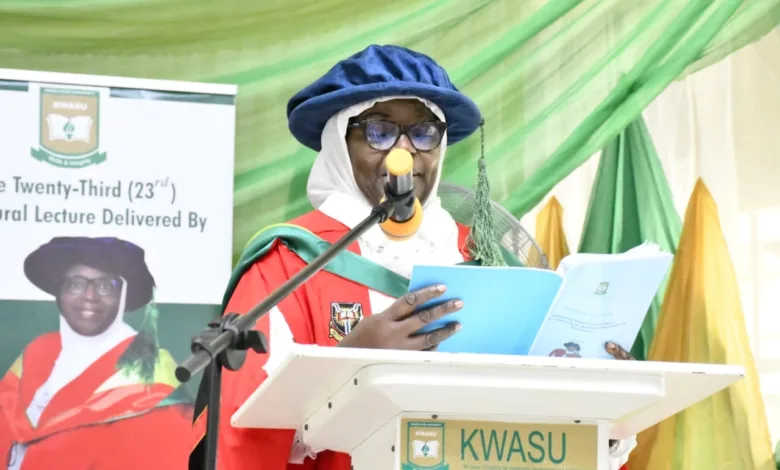
A Professor of Agricultural Economics at Kwara State University (KWASU), Malete, Taibat Moji Yusuf, has called for comprehensive reforms to eliminate the structural barriers preventing women from fully participating in Nigeria’s agricultural sector.
Yusuf made the call on Wednesday while delivering the university’s 23rd Inaugural Lecture, titled “Empowering Women Farmers in Nigeria: Closing the Gender Gap for Agricultural Transformation and Food Security.”
Drawing on more than three decades of field-based research, the professor said empowering women farmers remained critical to increasing agricultural productivity, strengthening food security and reducing poverty in Nigeria.

She specifically called for reforms to inheritance laws to guarantee women the right to own and inherit land irrespective of their marital status.
According to her, government should also encourage joint land ownership between married couples, noting that discriminatory land practices continue to limit women’s access to credit, agricultural inputs and other productive resources.
Yusuf also advocated gender-inclusive agricultural financing through microcredit schemes that do not require land as collateral.
She urged financial institutions to design loan products that reflect the realities of women farmers, particularly those in rural communities, while expanding digital financial services to improve their access to finance.
The don further called for reforms in agricultural extension services, including the recruitment of more female extension agents, flexible training programmes that take women’s domestic responsibilities into consideration, and the use of mobile technology to provide agricultural information in local languages.
She also stressed the importance of adult literacy, agricultural training and stronger cooperative organisations to enhance women farmers’ management skills, adoption of technology and bargaining power.
Yusuf called for greater access to mechanised processing equipment and other labour-saving technologies, alongside increased investment in rural water supply, electricity and childcare facilities to reduce the burden of unpaid domestic work on women.
She noted that improved roads, electricity and information and communication technology would also enable women farmers to diversify their income through off-farm employment, agro-processing and entrepreneurship.
The professor urged the government and private sector to expand contract farming and agricultural credit programmes through public-private partnerships that would guarantee farmers access to markets, inputs and financing.
She also recommended greater investment in post-harvest storage facilities, transportation, cold-chain infrastructure and market information systems to reduce food losses.
Yusuf further advocated the promotion of environmentally friendly agricultural technologies, including moringa-based bio-organic fertiliser, through agricultural extension services and cooperative production networks.
On policymaking, she called for mandatory gender-impact assessments for agricultural programmes, greater representation of women on agricultural policy committees, boards and farmers’ unions, as well as dedicated budgetary provisions for gender-responsive investments.
She maintained that agricultural policies must be integrated with poverty reduction, education and health initiatives, stressing that closing the gender gap in agriculture was essential to transforming Nigeria’s agricultural economy and achieving sustainable food security.
The professor said removing the barriers confronting women farmers would not only improve their livelihoods but also unlock their potential contribution to Nigeria’s agricultural transformation.







Police Arrest Man For Raping, Impregnating 12-year-old In Abuja

Wike Slams Amaechi For Blaming Tinubu For Mother’s Death

Medical Plane Carrying Six People Missing Off Us East Coast

Labour Party Youth Leaders Propose Backing Tinubu For 2027

Troops Rescue Five Abducted Women, Recover Rustled Livestock In Sokoto, Kasitina

Oyo Corps Members’ Abductors Threaten To Kill Victims; Parents Face N1bn Ransom Demand
-

 South West News5 days ago
Oyetola @72: YPF Celebrates Former Osun Governor, Hails Contributions to State, Nigeria’s Maritime Sector
-

 News3 days ago
Osun’s Monthly Allocation Rose to ₦17bn After Subsidy Removal, Says AMBO Group
-

 Economy3 days ago
Federal Workers Back ₦500 Petrol Demand, Threaten Strike Over Wages
-

 News5 days ago
Osun AGF Felicitates Oyetola At 72, Hails His Contributions To Governance