
News
Osun 2026: Will History Repeat Itself ?
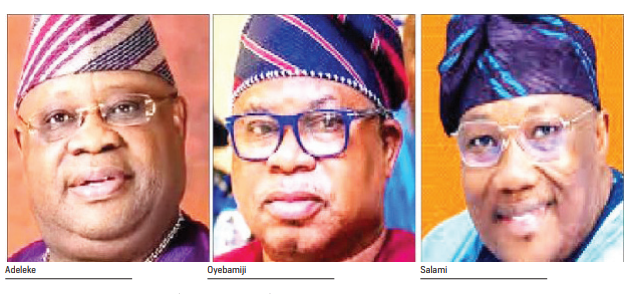
Osun 2026 Will History Repeat Itself
The Osun State governorship election is coming up in a few days. In the previous poll, Governor Ademola Adeleke defeated his All Progressives Congress(APC), who was in office. But in this analysis, AYOBAMI AGBOOLA, examines the odds, wondering whether history could repeat itself.
As Osun State prepares for the August 15, 2026 governorship election, one of the biggest questions dominating political discussions is whether the political formula that delivered victory to Governor Ademola Adeleke in 2022 can still produce the same outcome four years later.
The 2022 governorship election was largely defined by a unique convergence of political circumstances. Beyond the popularity of Adeleke himself, the election witnessed unprecedented alignments among opposition forces, widespread dissatisfaction with the
administration of former Governor Adegboyega Oyetola, internal divisions within the All Progressives Congress (APC), and the active or passive support of influential political figures whose contributions proved decisive.
However, the political environment has changed considerably. Realignments, defections, legal battles, internal party restructuring and increased federal political influence have altered the electoral landscape, making the 2026 contest fundamentally different from that of 2022.
Political observers argue that while incumbency offers Adeleke certain advantages, some of the factors that worked in his favour four years ago may no longer be available.
Defection of key political allies
One of the most significant developments ahead of the election is the departure of several influential politicians who were instrumental in the PDP’s victory in 2022.
Among them is Senator Francis Fadahunsi, a respected political leader in Osun East, whose grassroots political structure has remained influential over the years.
His mobilisation network was considered one of the strongest assets available to the PDP during the last governorship election. Similarly, Hon. Oluwole Oke, a longserving member of the House of Representatives, commanded enormous political influence, particularly across Obokun/Oriade Federal Constituency.
His political machinery contributed significantly to the PDP’s penetration into areas previously considered difficult electoral territories. Another notable figure is Honourable Sanya Omirin, alongside several other former PDP leaders who have since exited the party.
While the exact electoral impact of these defections will only become evident after the election, analysts believe their absence could weaken the PDP’s grassroots mobilisation in several strategic locations.
Political parties in Osun have historically relied heavily on local political structures rather than campaign rhetoric alone. Ward leaders, polling unit coordinators, community influencers and long-established political networks often determine voter turnout on election day.
The departure of experienced political gladiators therefore represents more than a mere change of party affiliation; it potentially affects the organisational strength that contributed to Adeleke’s emergence in 2022.
The Aregbesola factor
Perhaps no political factor shaped the 2022 election more than the internal crisis within the APC. The disagreement between former Governor Rauf Aregbesola and the leadership of the APC created one of the deepest divisions in the party’s history Although Aregbesola
did not openly campaign for Adeleke, many of his loyalists reportedly worked against the APC during the election, with political observers attributing a significant portion of Adeleke’s victory to the protest votes generated by the crisis.
In several local governments, supporters of the former governor allegedly worked quietly to ensure the APC suffered electoral setbacks. That political equation appears to have changed.
Many of Aregbesola’s loyalists are no longer believed to be quietly supporting Adeleke. Instead, a significant number are now openly pursuing different political interests through other platforms, particularly the African Democratic Congress (ADC).
The implication is that the protest votes which weakened the APC in 2022 may now be split among multiple political parties instead of benefiting Adeleke. For many analysts, this represents one of the biggest differences between both elections.
APC’s determination to return
Unlike the 2022 election where the APC was battling internal divisions, the party now appears more focused on reclaiming Osun Government House.
Party leaders have repeatedly described the August 15 election as one of their highest political priorities, arguing that Osun remains strategically important ahead of future national elections. The APC has intensified campaigns across the state, strengthened ward structures and embarked on aggressive voter mobilisation.
Its governorship candidate has consistently assured supporters that the party has learnt lessons from the 2022 defeat and is better prepared for the forthcoming election. Political analysts note that a united opposition often poses a greater electoral challenge than a divided one.
Local Government question
One of the most controversial issues ahead of the election has been the prolonged dispute over the control of local governments. The crisis has generated legal battles, political confrontations and differing interpretations of court judgments.
While the APC insists that its elected chairmen remain validly in office, the state government has maintained that those officials lack legal legitimacy. The dispute has resulted in the APC maintaining control of many local government councils.
Supporters of the state government argue that the inability of council officials elected on the platform of the PDP now Accord Party to fully exercise authority has affected grassroots governance and limited access to local government resources.
The APC, however, insists that its position is backed by judicial pronouncements and constitutional provisions. Whatever the legal position, the political implications remain significant.
Local governments traditionally serve as the closest political structures to voters. Whoever controls those structures often enjoys substantial organisational advantages during elections.
Security concerns and alleged intimidation
Another issue dominating the political atmosphere is the allegation of intimidation through arrests and security operations. Governor Adeleke has, on several occasions, alleged that members of his party have been arrested or subjected to undue pressure by security agencies.
The APC has consistently denied these allegations, maintaining that security agencies are merely carrying out lawful duties. Similarly, security agencies have repeatedly stated that their operations are based on intelligence and law enforcement responsibilities rather than political considerations.
Nonetheless, the recurring accusations have become part of the broader political narrative surrounding the election. Whether these claims influence voter perception remains to be seen.
Freezing of Government account
The reported freezing of an Osun State Government account by the Economic and Financial Crimes Commission (EFCC), barely days before the election, has also generated widespread debate.
The state government described the action as politically motivated and warned that it could affect salary payments and government operations.
The EFCC has maintained that its actions were guided by investigations and legal procedures, especially following allegations of suspicious withdrawals.
Opposition parties have also offered differing interpretations of the development. Reprieve however, came the way of the governor as the governor as President Bola Tinubu not only considered the action as embarrassing, but ordered the commencement of legal action to de-freeze the accounts.
But it has been observed the order was too little, too late, and the action may have weaved public sympathy to the favour of Adeleke. It is perceived as part of the desperation of the APC to suffocate the government.
Critics noted that coming after the release of Local Government funds to APC loyalists, the latest action raised further suspicions, bothering on double standards.
The question is did the EFCC freeze the accounts of Kogi, Anambra and Bayelsa states during the off-season elections? If not, what has changed. Regardless of the reversal, the timing of the action has become a major campaign issue, with each political camp using it to reinforce its narrative.
Motor Parks controversy
Another politically sensitive issue has been the struggle over the control of motor parks across the state. The controversy followed disputes involving transport unions and the emergence of another leadership associated with Kazeem Oyewale, popularly known as “Asiri Eniba.”
The development generated protests, security interventions and accusations from opposing political camps. Supporters of the government argue that the takeover weakened one of the grassroots mobilisation structures traditionally relied upon during elections.
The opposition maintains that actions taken regarding motor parks were lawful and necessary. Regardless of the competing narratives, transport unions remain influential political stakeholders in Osun politics.
Alleged federal influence
The opposition has frequently accused the Federal Government of deploying federal institutions to influence political developments in Osun. These allegations have featured prominently in campaign speeches and public statements by the governor and leaders of his party.
The APC rejects these claims, insisting that institutions of government are acting independently and within the law. Political analysts note that perceptions often shape electoral behaviour as much as realities.
The debate over “federal might” has therefore become an important element of public discourse leading to the election. Tinubu’s “All Is Fair in Politics” Comment Another issue that has attracted attention is President Bola Tinubu’s statement that “all is fair in politics.”
The remark has generated varied interpretations across political circles. Supporters of the President argue that the statement reflects the competitive nature of politics and should not be interpreted as an endorsement of illegality.
Critics, however, contend that such comments could be perceived as encouraging hardball political tactics at a time when Nigerians expect stronger commitments to democratic norms, electoral fairness and institutional neutrality.
For many civil society organisations and election observers, public confidence in elections depends not only on the actions of political actors but also on the language used by national leaders.
Political communication experts argue that statements made by highly influential leaders often shape public perception, especially during highly competitive elections.
Incumbency, Adeleke’s biggest asset
Despite the changing political landscape, Governor Adeleke is not entering the election without significant strengths. As the incumbent governor, he has the advantage of visibility, ongoing infrastructure projects, social intervention programmes and the opportunity to campaign on his administration’s record.
His supporters argue that roads, schools, healthcare projects and workers’ welfare initiatives have strengthened his appeal among voters. Whether these achievements will outweigh the changing political dynamics remains one of the defining questions of the election.
An election unlike any other
The August 15 governorship election appears fundamentally different from the contest that brought Adeleke to power in 2022. The coalition of political interests that helped produce victory has changed considerably.
Former allies are now in different political camps. The internal divisions that weakened the APC have largely reduced. Fresh legal and political controversies have emerged. Federal political influence has become a major campaign issue.
New parties are competing for votes that previously flowed largely to one opposition platform. Ultimately, the outcome of the election will depend on whether Governor Adeleke’s record in office is sufficient to compensate for the loss of some of the political advantages
that characterised the 2022 contest, or whether the APC’s renewed determination, combined with shifting political alliances and a transformed electoral environment, will be enough to reclaim Osun Government House.
Whichever way the pendulum swings, one thing appears certain: the political calculations of 2022 cannot simply be replicated in 2026.
Osun’s political landscape has evolved, alliances have shifted, and the electorate will once again determine whether performance, party structures, political realignments or broader national dynamics will shape the state’s next chapter.
© New Telegraph











Army Kills Kidnapper, Rescue Abducted Farmer in Edo

16 Rescued Alive After Building Collapse in Kano

Snakebite Deaths: FG Gives Benue 100 Vials Of Anti-snake Venom

Osun 2026: Strengths And Weaknesses Of Adeleke, Oyebamiji, Salaam as Voters Head To Polls

Police Arrest Osun Commissioner Over Gunshots At APC Rally; Adeleke kicks

Scavengers Vandalise Lagos Bridge, Strip Pillars Of Iron Bars
-
 News5 days ago
KRAD Donates ₦1m as Ifon-Orolu Celebrates Annual Odun Adé Festival
-
 News4 days ago
Sokoto’s ₦1.7bn NYSC Camp Rehabilitation Hits 80% Completion
-

 News4 days ago
Osun 2026: Davido Calls For Peace, Respect For People’s Mandate
-
 News5 days ago
Osun 2026: Campaign On Issues, Not Allegations, APC Scribe Tells Adeleke