
News
Today’s Opposition Gathering in Abuja: The Choice Before Presidential Candidates

The Ibadan Declaration of April 2026 was a beautiful document – a poem of political intent, signed with the ink of desperation. But as the opposition leaders meet once again today in Abuja, the gathering of Nigeria’s political heavyweights resembles not an army preparing for battle, but a fleet of captains, each insisting that only his vision can rescue the nation.
In Tony Blair’s A Journey, he writes of the “journey from Opposition to government” as a time when “every day drags. Every week a fresh anxiety or event or statement disturbs the careful orchestration of the march from impotence to power”. President Tinubu’s tenure which is in its fourth year of what his minders call “Renewed Hope,” shows the opposition appear to have finally woken to the reality of survival. But will its leaders learn the lessons that history, both near and far, has taught?
The Mathematics and Reality of Survival
The question before the opposition is not whether to unite, but whether they can. And here, the record is unforgiving. In Kenya’s 2002 elections, an opposition coalition defeated KANU, which had ruled for 39 years. Yet scholars argue that the coalition only had “partial influence” – equally significant were “the split within KANU” and “public disaffections with prevailing economic living conditions”.
Similarly, in 2015, the then ruling Peoples Democratic Party (PDP), under the presidency of Goodluck Ebele Azikiwe Jonathan, was defeated at the polls by the All Progressives Congress (APC), after 16 years in office. Through a combination of in-fighting in the PDP, insider conspiracy and strong mobilisation by the coalition, the opposition defeated the PDP.
The point is that incumbents are rarely defeated by opposition unity alone; they are defeated when their own foundations crack and public anger reaches a boiling point.
Today, President Tinubu’s foundations show hairline fractures. Multi-dimensional poverty stalks the land. The cry of hunger has increased in decibel because what should have gone round appears to be concentrated in the hands of a few. Yet the opposition remains divided, its leaders held hostage by their own ambitions.
The Captains and Their Ships
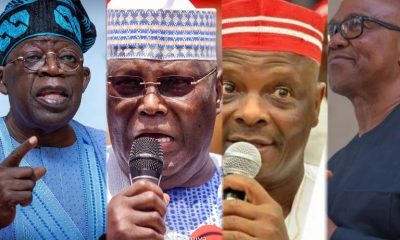
Atiku Abubakar, who has run for president more times than many Nigerians have voted, now carries the flag of the ADC – he has Rotimi Amaechi as his running mate. Peter Obi, the social media phenomenon, who commands the Obidient movement has reached out to Rabiu Musa Kwankwaso as his tag-team partner to lead the NDC ticket. Seyi Makinde has now joined the fray. Each sits atop a structure, structures and personal war chests built around their individual ambitions.
Today’s opposition resembles a football team with five captains and seven people insisting they should be the coach. Everybody cannot wear the armband. Ambitions would have to be sacrificed for strategy. That sacrifice has not yet been made.
The Weight of Incumbency
The power of incumbency is not a gentle breeze but a hurricane. Tinubu’s grip on the legislative arm is “seemingly unmatched”. The APC controls the machinery of government, possesses significant organisational structures, and enjoys the advantages that naturally accompany sitting presidents. Nigeria’s judiciary presently has in its fold some justices whose pronouncements continue to pour cold water on the expected integrity and competence of that arm of government.
Worse still, the electoral umpire, INEC, is viewed with deep suspicion. As one analyst puts it, “Nigerians now view election results announced by INEC with grave suspicion or sometimes outright disbelief”.
The Burden of Choice
The G100’s summit, billed for today, is not intended to “determine, in a single sitting, questions of presidential candidacy”. Instead, it seeks to establish “a formal architecture through which those questions can be negotiated collectively, transparently and in good faith”. This is diplomatic language for postponing the inevitable bloodshedding.
Who will step down for whom? This is the question that sank the Ibadan project, and it remains unanswered. The NDC has already declared Peter Obi “the brightest, best and most popular candidate in the opposition”. Atiku’s camp will say the same about their man.
The North/South Dichotomy
Yet, there is the nagging issue of the North/South dichotomy. Whereas the 1999 Constitution of the Federal Republic of Nigeria, as amended, recognises the balancing of power between the North and South, in December 2002, the PDP, via an expanded caucus meeting inside Aso Rock Presidential Villa cemented it by voting for power to be held by the South for eight years, after which it would return to the North for another eight years. This was in the build-up to Obasanjo’s second term bid. Obasanjo pulled all the stops to ensure that Umaru Musa Yar’Adua emerged as the PDP candidate in 2007 and the latter won to become president. Unfortunately, the cold hands of death snatched Yar’Adua and Jonathan finished his term but still contested in 2011 and won. But he had broken the eight-year rule.
Part of the sentiments that drove the mobilisation against Jonathan stemmed from the perceived sidelining of the North and its supposed, entitled eight years, apart from Jonathan’s governance discount. Buhari did his eight years.
Tinubu, a southerner, is about to finish his first term of four years. The South expects to serve eight years. The opposition would be wise to factor the sentiments effusing from the South about its entitlement to eight years, while not discounting the massive northern votes needed by any candidate to win Nigeria’s presidential election, when it decides on who to present as a consensus/coalition candidate.
The Ghost of Ubuntu
There is an ancient African philosophical worldview rooted in Ubuntu – “I am because we are”. It is a creed that demands sacrifice of the individual for the collective. But Nigerian opposition politics has become a theatre of the ego, where personal ambition masquerades as national service.
History beckons. Yar’Adua is still remembered for his humility, even though his health challenges cut his vision short. The opposition has an opportunity to present itself as the alternative – but only if it can forego personal political gains and present a leader “truly committed to and interested in the overall sanitisation of Nigeria’s political sphere”.
The Verdict
As the opposition gathers in Abuja, the question is not whether they can defeat Tinubu – he remains formidable, and his allies predict “the easiest contest of his career”. The question is whether they can defeat themselves. The capacity for self-sabotage in Nigerian politics is legendary.
If history teaches us anything, it is that opposition coalitions succeed when they are born of genuine sacrifice, not when ambition is merely papered over with communiqués. The Ibadan Declaration was a start. What follows will determine whether it was poetry or epitaph.
Who will tell the opposition leaders that history rewards the selfless, not the ambitious? Who will tell them that the gathering of eagles means nothing if they cannot fly in formation?
But who will tell the opposition?











Tinubu, Idris, And A Whole New 2027 Campaign, by Suleiman A. Suleiman

Dollar to Naira Exchange Rate Today, August 31, 2026

Steel Imports Bleed Nigeria’s economy

Xenophobic: Tinubu Drags South Africa to AU

Police Bust Alleged Kidney-Harvesting Syndicate in Nasarawa, Arrest Two Doctors

Troops Kill Terrorist Commander ‘Smally’, Recover Weapons, Motorcycles In Katsina
-
 News5 days ago
₦605/Liter Is Our Starting Sustainable Price For Petrol — Gbenga Hashim
-
 News5 days ago
EAPEAN, GAaNF e.V. and 360° Labour Mobility Alliance Strengthen Partnership on Safe and Ethical International Recruitment
-
 News4 days ago
Owalare Congratulates Adeleke On Re-election, Commends Development Efforts
-
 Economy5 days ago
US Will Achieve Nothing With Economic Pressure – Iran president