News
NUC Board Chairman Demands Harmonisation Of University Regulatory System
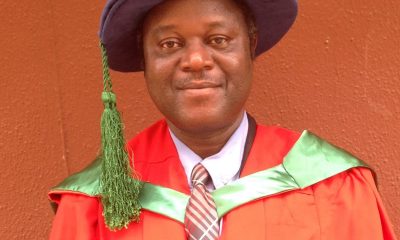
The Chairman of the Governing Board of the National Universities Commission (NUC), Prof. Oluwatoyin Ogundipe, has called for an urgent overhaul and harmonisation of Nigeria’s university regulatory framework to eliminate overlapping mandates, duplicated accreditation processes and unnecessary financial burdens on institutions.
Ogundipe said the country’s dual regulatory system, involving the NUC and professional regulatory bodies, had become increasingly problematic as the university system expanded, creating situations where institutions were sometimes compelled to satisfy conflicting or overlapping requirements.
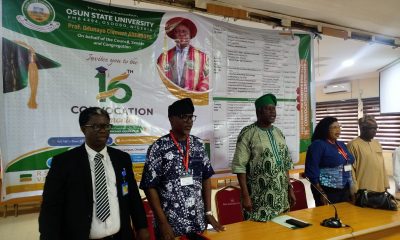
He spoke on Thursday in Osogbo while delivering a lecture at the 16th convocation ceremony of Osun State University (UNIOSUN).
The NUC board chairman described the existing regulatory arrangement as “structurally necessary but operationally dysfunctional,” stressing that the solution was not to weaken regulation but to make it more coordinated, efficient and responsive to the needs of students and the wider public.
“Quality assurance must remain non-negotiable but could become counterproductive when multiple regulators impose inconsistent requirements and duplicate processes, leaving universities and students to bear the consequences,” Ogundipe said.
He explained that the NUC and professional regulatory bodies had co-existed for decades, but the rapid expansion of universities from the 1990s had exposed structural tensions within the system and increased the cost of regulatory compliance.
According to him, the challenges included conflicts over curriculum ownership, uncoordinated accreditation timelines and costs, as well as gaps between NUC minimum academic standards and the professional standards prescribed by regulatory councils.
Ogundipe noted that some university departments had been compelled to restructure their programmes to meet NUC benchmarks only to encounter additional requirements from professional regulatory bodies.
He said such a situation often resulted in repeated restructuring, financial pressure on institutions and diversion of academic staff from teaching and research to regulatory compliance.
He therefore urged university authorities to move from a reactive approach to a more proactive engagement with regulators, stressing that university leaders must play a central role in reforming the regulatory architecture.
“As Vice-Chancellors, Pro-Chancellors and members of governing councils, we are not passive recipients of regulatory policy. We have both the opportunity and the duty to lead its transformation,” he said.
Ogundipe called on the Committee of Vice-Chancellors of Nigerian Universities (CVC), in collaboration with the Association of Private Universities and the Committee of Pro-Chancellors, to pursue coordinated advocacy for a system-wide regulatory reform.
He proposed a six-point implementation agenda, including the establishment of a national task group comprising the NUC, professional regulatory bodies and university representatives to identify overlapping programme requirements and develop unified regulatory matrices for affected disciplines.
The NUC board chairman also advocated enforceable student-protection measures, including early public disclosure of accreditation status and clear remediation plans for programmes facing regulatory challenges.
Other recommendations included institutionalising regulatory intelligence through dedicated quality-assurance structures linked to university Senates, managements and governing councils, as well as strengthening collective advocacy to make regulatory harmonisation a national higher-education policy priority.
Ogundipe further urged universities to make accreditation preparation part of their routine operations rather than treating it as a crisis-management exercise.
He commended UNIOSUN for demonstrating that a state-owned university could obtain rigorous accreditations while producing graduates capable of making meaningful contributions to society.
Earlier, the Vice-Chancellor of UNIOSUN, Prof. Clement Adebooye, appreciated Ogundipe for his contributions to the development of university education in Nigeria.
Adebooye also commended Governor Ademola Adeleke for his support for the institution, saying the university had continued to expand under successive administrations.
The Vice-Chancellor disclosed that UNIOSUN had grown from 66 academic programmes at inception to 128, while its student population had risen from 14,680 to 42,780.
He added that postgraduate programmes had increased from 99 to 299, while the university had secured 75 international grants, which he described as evidence of its growing academic and research profile.
Adebooye expressed appreciation to stakeholders who had contributed to the growth of the institution and urged the university community to sustain its commitment to academic excellence, research and institutional development.










Osun APC Kicks Against Park Management Law, Demands Withdrawal

Osun: Alowonle’s Associate Reportedly Arrested Over Murder Of Ajagungbade Emir

500 Youths To Attend Osun Scout’s Camporee 2026

NUC Board Chairman Demands Harmonisation Of University Regulatory System

2027: Hashim, Makinde Discuss Government Of National Unity