

News
Reaching Zero-Dose Children Key To Nigeria’s Development- UNICEF
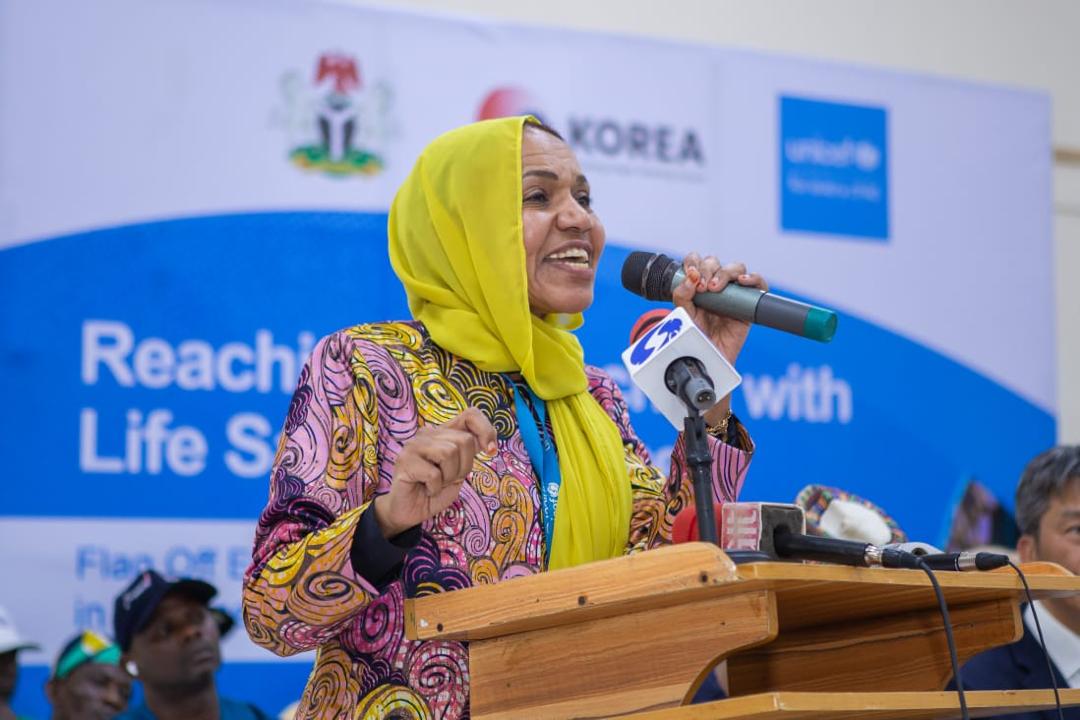
The United Nations Children’s Fund (UNICEF) has emphasised that reaching zero-dose children is a national development priority, not merely a health intervention.
UNICEF Nigeria Country Representative, Wafaa Saeed, stated this on Thursday at the flag-off of the Republic of Korea–UNICEF Investment in Routine Immunisation programme in Badagry Local Government Area of Lagos State.
Saeed noted that healthy children are fundamental to human capital development, productivity, and social cohesion.
She revealed that with an estimated 2.2 million zero-dose children, Nigeria has the highest number of children in Africa who have never received a single routine vaccine, and one of the highest globally.
“This reality places a shared responsibility on all of us. These are not just statistics; they are real children, often living in fragile urban settlements, border communities, conflict-affected settings, and hard-to-reach areas without access to essential services.
“This burden is not a failure of science—vaccines work. Rather, it reflects enduring challenges related to equity, access, and service delivery. This is why strong political leadership and partnerships are essential,” she said.
Saeed commended the Federal Government, the National Primary Health Care Development Agency, and State Primary Health Care Boards for prioritising zero-dose children, particularly through targeted interventions in high-burden local government areas and communities.
She also expressed appreciation to the Government of the Republic of Korea for its support.
“Through this partnership, Korea has demonstrated that global health security begins by reaching the most excluded populations. Nigeria’s inclusion in this investment reflects both the scale of need and confidence in the country’s capacity to deliver results,” she said.
Saeed added that UNICEF would continue to support the government by leveraging global expertise, operational reach, and community trust to ensure that national commitments translate into measurable impact.
“We are proud to be a trusted partner of the Government of Nigeria and the Republic of Korea. Together, we can reach zero-dose children and strengthen the national health system,” she added.
Also speaking, the Consul General of the Republic of Korea, Lee Sang Ho, said Nigeria’s high number of unvaccinated children poses a significant threat to global health security, justifying Korea’s investment under the Access to COVID-19 Tools Accelerator framework.
“The risk to global health security is increasing, particularly in high-burden African countries. This investment aims to reduce zero-dose and under-immunised children while strengthening Nigeria’s healthcare system,” he said.
He disclosed that about $5.6 million had been earmarked for Nigeria under the current phase of the programme, targeting 40 local government areas across Lagos, Ogun, Niger, Bauchi, Adamawa, and the Federal Capital Territory.
In his remarks, Lagos State Commissioner for Health, Prof. Akin Abayomi, represented by a director in the ministry, said the initiative aligns with the state’s drive for inclusive growth amid rapid urbanisation and population pressures.
“One of the most pressing public health challenges we face is the persistence of zero-dose and under-immunised children, particularly in densely populated and hard-to-reach communities,” he said.
Abayomi noted that the programme would deploy data-driven strategies, strengthen frontline health workers, and expand equitable access to vaccines among vulnerable populations.
“This partnership demonstrates how global collaboration can translate into real impact at the community level, ensuring no child is left behind,” he added.
Also speaking, the Chairman of Badagry Local Government Area, Babatunde Hunpe, described the programme as critical for border communities where access to healthcare remains limited.
“A community where children grow up healthy is the foundation of development. Immunisation is not just a health issue; it is central to our collective progress,” he said.
He urged mothers, community leaders, and health workers to embrace the initiative, stressing that no child should be left unprotected due to distance, ignorance, or socio-cultural barriers.
“From the most accessible parts of Badagry to the remotest border settlements, we must ensure every child receives these life-saving vaccines,” Hunpe added.
The programme, which will be implemented across six states, will leverage Nigeria’s existing health systems to identify missed children, scale up vaccination campaigns, and integrate community-based services aimed at closing the immunisation gap and strengthening national health security.











Transporters Condemn Uber’s Sudden Exit From Nigeria, Warn Bolt, InDrive

Dollar To Naira Exchange Rate Today, September 3, 2026

2027: INEC Awaits Full Budget Release To Replace Damaged BVAS

4.85m Customers Still Unmetered

Credit To Private Sector Declines 15% In July

Police Dismiss Viral Video Of Officers Allegedly Fleeing From Drone
-

 Crime2 days ago
Police Probe Osun Man Over Alleged ₦22.3m Farmers’ Grant Scam
-
 News5 days ago
Osun Election: AMBO Congratulates Adeleke, Condemns Post-Election Killings, Urges APC Members To Mobilise For 2027
-
 News4 days ago
2027: I’ll Deliver Osun Votes To Tinubu, Adeleke Assures
-

 News3 days ago
₦605 Petrol Price Is Starting Point, We Can Cut It to ₦200–₦300 — Olawepo-Hashim