News
Why My Father Hid My Hausa, Royal Identity For 27 Years — Gbenga Hashim
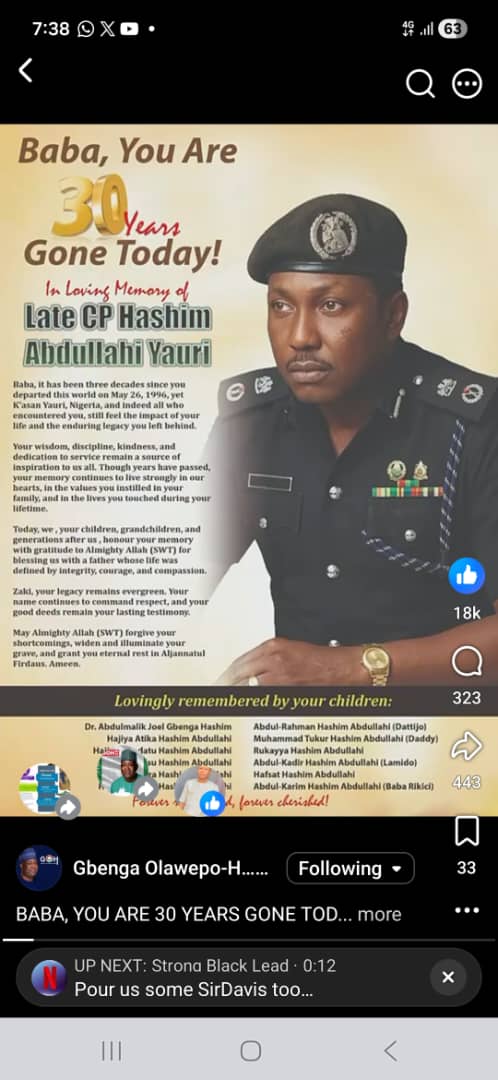
The Presidential candidate of the Accord Party, Dr. Gbenga Hashim, has revealed how his father deliberately concealed his Hausa and royal heritage from him for nearly three decades, in what he described as an attempt to protect him from possible danger within the family.
Hashim, who is a grandson of the 40th Serki of Yauri, disclosed that his late father, Alhaji Hashim Abdullahi Yauri, made the decision after receiving a warning from an Islamic cleric about possible dangers associated with exposing the child’s royal identity at an early age.
According to him, the cleric advised his father against revealing his identity prematurely, prompting the former police officer to choose what he considered the safest option for his son.

“He chose protection over inheritance,” Hashim said, recalling his father’s decision.
Following the decision, Hashim said he was relocated and raised in the Borgu Emirate under a different identity. Although he was named Abdulmalik at birth, he grew up largely within a Yoruba cultural environment, with little knowledge of the Hausa traditions, royal connections and history of his paternal family.
For about 27 years, he said, he lived without knowing the full circumstances surrounding his birth and identity.
The remarkable account is contained in Chapter 13 of his forthcoming autobiography, Sunrise At Midnight, which is scheduled for publication soon. The chapter chronicles his childhood, his father’s decision to conceal his heritage and the eventual discovery of the family history that had remained hidden from him for decades.
Hashim had previously spoken about his unusual childhood in an interview with THISDAY, where he disclosed that he was born in Yelwa, Yauri, in 1969, while his father was serving as a young police officer. He later grew up with the family of his stepfather, Julius Bamidele Olawepo.
He also paid tribute to his late father, describing him as an influential police officer who rose through the ranks to become a Police Commissioner and Commandant of the Police College, Kaduna.
Popularly known as “Zaki”, meaning “The Lion”, Alhaji Hashim Abdullahi Yauri was, according to his son, widely respected across Northern Nigeria for his courage, discipline, strength and commanding personality.
Hashim and his siblings recently marked the 30th anniversary of their father’s death with commemorative advertisements published in major Nigerian newspapers.
For Hashim, the story of his father is closely intertwined with his own journey of self-discovery and understanding of his family heritage.
He traced his paternal lineage to his grandfather, Serki Abdullahi Jibril, popularly known as Maiy Yauri, whom he described as one of the prominent traditional rulers in Northern Nigeria during his era.
Hashim said his grandfather belonged to a generation of educated Northern royals who combined traditional authority with modern education, administration and commerce.
He described Seriki Jibril, the 40th ruler of Yauri, as a prominent royal of Hausa ancestry who was distinguished by his knowledge of finance and trade, financial prudence, transparency and commitment to education.
According to him, his grandfather was also honoured with the Officer of the Order of the British Empire (OBE) during the colonial period.
Hashim further recalled that British records portrayed his grandfather as an unusually independent traditional ruler who, during the Second World War, exercised a measure of administrative autonomy that distinguished him from some of his contemporaries.
However, Hashim said the significance of his story goes beyond his royal ancestry.
Rather, he described it as the story of a father who chose secrecy as a means of protecting his child, a child who grew up between different cultural environments without knowing the full circumstances of his origins, and a family history that eventually resurfaced decades later.
“For 27 years, I lived without knowing the full story of who I was,” Hashim said.
He explained that the eventual discovery of his Hausa and Yauri heritage did not diminish the Yoruba cultural environment in which he was raised.
Instead, he said, it provided him with a broader understanding of the different cultural and historical influences that shaped his identity.
For Hashim, the experience remains a deeply personal story about family, sacrifice, identity and heritage, as well as the unpredictable ways in which long-hidden chapters of a person’s history can eventually return to shape their understanding of themselves.















Osun APC Kicks Against Park Management Law, Demands Withdrawal

Osun: Alowonle’s Associate Reportedly Arrested Over Murder Of Ajagungbade Emir

500 Youths To Attend Osun Scout’s Camporee 2026

NUC Board Chairman Demands Harmonisation Of University Regulatory System

2027: Hashim, Makinde Discuss Government Of National Unity