
News
Osun Guber: The Forces Behind Governor Adeleke ’s Second-Term Victory
By Ayobami Agboola, Osogbo
On August 15 2026, residents of Osun State trooped out massively to exercise their civic responsibility in what could be termed as resistance and total determination to ensure they exercise their franchise and vote for the candidate of their choice, despite the tension few days before the election.
In this analysis AYOBAMI AGBOOLA looks at the forces behind Governor Ademola Adeleke victory from projects and workers’ votes to sympathy, political controversies, family influence and APC’s internal cracks, how Adeleke secured another four years at the Osun Government House.
When Governor Ademola Adeleke started praising lord after the Independent National Electoral Commission declared him winner of the August 15, 2026 Osun governorship election, the victory was more than a routine triumph of an incumbent over a challenger.
It was a victory that reflected a combination of factors — personal popularity, performance, workers’ support, political strategy, family influence, sympathy, opposition miscalculations, religious faith and, perhaps most importantly, the ability of the governor to maintain a direct emotional connection with a significant section of the electorate.
Adeleke, candidate of the Accord Party, polled 511,067 votes, defeating the All Progressives Congress candidate, Asiwaju Munirudeen Bola Oyebamiji, who scored 444,815 votes, a winning margin of 66,252 votes.
He also won 19 of the state’s 30 Local Government Areas, while Oyebamiji won 11.
But what exactly worked for Adeleke?
Why did a governor who had spent much of the campaign fighting political battles with a powerful opposition party, federal institutions and sections of the security establishment still manage to return to office?
The answer lies in a combination of factors.
-ACCEPTABILITY: ADELEKE’S PERSONAL CONNECTION WITH THE PEOPLE
Perhaps the most important factor was Adeleke himself.
From the beginning of his administration, the governor deliberately cultivated an image different from the conventional Nigerian politician.
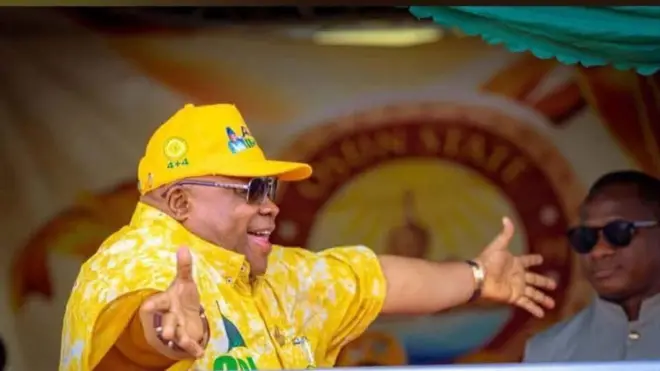
He dances at public functions. He sings. He celebrates with market women, artisans, students and traditional rulers. He frequently mixes politics with entertainment and does not appear uncomfortable displaying emotion in public.
For his supporters, these characteristics have made him relatable.
To many residents, Adeleke is not simply the governor occupying the Government House in Osogbo; he is a politician who has successfully created an emotional connection with the electorate.
That connection became particularly important during the campaign.
While his opponents attempted to portray the election largely as a referendum on his administration, Adeleke and his supporters succeeded in making it a contest between what they described as continuity and a return to the past.
The governor repeatedly asked voters whether they wanted to return to what his administration described as the era of half salaries, pension arrears and infrastructural neglect.
That argument resonated with sections of the electorate.
Indeed, months before the election, the governor’s camp claimed internal opinion surveys showed his approval rating between 68 and 72 per cent. Although those figures were campaign claims rather than independent polling data, the final result showed that Adeleke had succeeded in maintaining a formidable level of popular support.
PROJECTS THAT BECAME POLITICAL CAPITAL
The second major factor was infrastructure.
Adeleke’s administration spent considerable political capital on physical projects across the state.
Roads became one of the most visible symbols of the administration.
The government claimed hundreds of kilometres of roads had been constructed or rehabilitated, alongside township road dualisation projects, flyovers, bridges and urban renewal initiatives.
The administration also highlighted projects in Osogbo, Ede, Iwo, Ile-Ife, Ila-Orangun, Ikirun and other parts of the state.
The July commissioning of the Lameco Flyover in Osogbo provided one of the most powerful campaign images for the governor.
At the commissioning, Adeleke said his administration had completed more than 300 kilometres of intra-city roads since taking office.
There were also investments in healthcare, education, water supply, sports and technology.
The administration pointed to the rehabilitation of health centres, the development of water projects, rehabilitation of schools, interventions at Osun State University, the University of Ilesa and the construction of a new stadium.
Whether every project met the expectations of every resident is debatable. But politically, the projects gave Adeleke something every incumbent needs during an election — visible evidence of government activity.
For voters travelling through Osun, the roads and other infrastructure projects were not campaign promises. They were physical structures they could see.
That matters enormously in electoral politics.
THE WORKERS’ VOTE: ADELEKE BUILT A FORMIDABLE LABOUR ALLIANCE
If there was one constituency that gave Adeleke a major political advantage, it was organised labour.
The governor’s relationship with workers became one of the strongest pillars of his re-election campaign.
In December 2025, labour leaders under the NLC and TUC publicly endorsed Adeleke and the Accord Party. The NLC leadership said workers had a stake in ensuring his return.
Earlier, in May 2025, workers had also endorsed his second-term bid, citing his handling of salaries and other welfare issues.
The administration’s narrative was straightforward: it inherited salary and pension liabilities and had taken steps to address them.
The government highlighted payment of inherited half-salary arrears, pension obligations, wage awards and the implementation of a new minimum wage structure.
This became particularly significant because civil servants do not vote alone.
They have families. They have spouses. They have parents. They have friends and neighbours. They are members of communities. Thus, the support of organised labour could translate into a broader electoral network.
The NLC and TUC endorsement therefore represented much more than a ceremonial political statement.
It was an indication that Adeleke had succeeded in turning workers’ welfare into electoral capital.
THE PENSIONERS’ FACTOR
Closely connected to the workers’ vote was the pensioners’ constituency.
In June 2026, the Nigeria Union of Pensioners in Osun endorsed Adeleke for another term, citing what it described as his commitment to retirees’ welfare.
The pensioners pointed to measures including pension payments, the ₦25,000 monthly wage award and access to the Osun Health Insurance Scheme.
This constituency is politically significant.
Pensioners are not merely retirees. They are parents, grandparents and community influencers.
A government that wins the confidence of pensioners can potentially influence entire family networks.
SYMPATHY VOTES AND THE POLITICS OF PERCEIVED PERSECUTION
Perhaps the most complicated factor in Adeleke’s victory was the politics of persecution.
Throughout the campaign, the governor and the Accord Party repeatedly alleged that federal institutions and opposition-linked forces were attempting to frustrate his administration and intimidate his supporters.
The controversies included the local government crisis, disputes over control of council structures and funds, allegations of politically motivated arrests, the reported detention of Accord members and disagreements between the government and the police.
In July, the Adeleke campaign alleged that more than 86 Accord members had been arrested within a few days and described the arrests as politically motivated.
In another incident, the campaign council alleged that an Accord House of Representatives candidate and other party members had been arrested by police officers.
The police and other authorities offered their own positions on such incidents, meaning the allegations should not be treated as established facts.
But elections are often determined not only by facts but also by perception.
Among Adeleke’s supporters, these developments reinforced the narrative that their candidate was being politically targeted.
And that perception could have produced sympathy.
THE LOCAL GOVERNMENT CRISIS
The prolonged crisis over the control of Osun’s local governments also became a major political issue.
Adeleke’s administration maintained that elected council officials should be allowed to operate and accused the APC of attempting to control local government structures.
The APC, on the other hand, rejected the governor’s interpretation of the dispute.
The controversy became a political symbol of the broader struggle between the Adeleke administration and APC interests in the state.
To Adeleke’s supporters, it represented an attempt to undermine the government.
To his opponents, it was evidence of the governor’s inability to accommodate opposition interests.
The important point politically was that the governor successfully presented himself to his supporters as the underdog fighting a powerful political establishment.
That is often a potent electoral narrative.
THE EFCC ACCOUNT FREEZE: A LAST-MINUTE POLITICAL ADVANTAGE?
Then came the EFCC controversy.
On August 5, barely 10 days before the election, the Economic and Financial Crimes Commission confirmed that it had placed a Post-No-Debit restriction on an Osun State Government account.
The EFCC said it was investigating alleged financial transactions involving about ₦11 billion and argued that the restriction was intended to protect public funds.
The Adeleke administration rejected the action and described it as politically motivated.
The timing was politically explosive.
Whatever the legal merits of the EFCC’s action, the development allowed Adeleke’s campaign to reinforce its existing narrative of persecution.
To a section of voters, the question became less about the details of the EFCC investigation and more about why such action was coming immediately before a governorship election.
That created another opportunity for the Adeleke camp to mobilise sympathy.
The political message was simple:
“They are coming after us because they cannot defeat us at the polls.”
For an incumbent seeking sympathy, it was a powerful narrative.
THE POLICE CONTROVERSY AND THE PSYCHOLOGY OF INTIMIDATION
The same dynamic applied to allegations of harassment and intimidation.
The Accord Party repeatedly accused the police of targeting its members, while the police maintained that its operations were professional and intelligence-driven.
The disagreement became a recurring feature of the campaign.
Again, the political consequence may have been more important than the original controversy.
Every arrest, allegation or confrontation became campaign material.
Adeleke’s supporters increasingly saw the election as a battle for political survival.
And once an election becomes a perceived struggle between “us” and “them”, supporters tend to become more determined to vote.
FADAHUNSI AND THE POLITICS OF WORDS
The controversial comments attributed to Senator Francis Fadahunsi also became part of the political atmosphere.
Fadahunsi, a prominent APC figure in Osun, had been one of the voices involved in the intense political confrontation with the Adeleke camp.
The governor’s camp repeatedly accused him and other APC leaders of promoting an atmosphere of political hostility — allegations the opposition rejected.
In July, Adeleke even called for sanctions and visa restrictions against Fadahunsi, Gboyega Oyetola, Oyebamiji and other APC figures over alleged political violence.
Whether the comments attributed to Fadahunsi were intended as political rhetoric or not, the reactions they generated demonstrated the danger of inflammatory political language.
In a tense election, statements perceived as threats against a candidate’s supporters can easily transform into mobilisation tools.
For Adeleke’s camp, every controversial statement from the opposition could be presented as evidence that its supporters were under threat.
DIVINE GRACE: ADELEKE’S UNUSUAL POLITICAL SPIRITUALITY
There is another factor that is difficult to quantify but impossible to ignore in Adeleke’s political journey: faith.
The governor frequently praises God publicly.
He sings. He dances. He gives thanks.
After major political victories or difficult moments, Adeleke often returns to the language of divine intervention.
To his supporters, this has become part of his political identity.
There is a widespread belief among his followers that Adeleke has repeatedly survived political challenges because of what they describe as divine grace.
This belief cannot be measured by conventional electoral statistics.
But politics is not only about statistics.
It is also about narratives.
And Adeleke has successfully constructed a narrative around himself as a man who may be underestimated, attacked or written off, but somehow survives.
That narrative was evident again after his latest victory.
THE ADELEKE FAMILY: A POLITICAL BRAND THAT EXTENDS BEYOND GOVERNMENT
The Adeleke family name is another major electoral asset.
The family has deep roots in Osun politics.
The late Senator Isiaka Adeleke remains an important political figure in the state’s history, while other members of the family have maintained strong political and social influence.
Governor Adeleke has therefore never operated merely as an individual politician.
He carries a family brand that has been cultivated over decades.
In Osun politics, the Adeleke name is already familiar to voters.
That familiarity matters.
DAVIDO: WHEN MUSIC BECOMES POLITICAL CAPITAL
And then there is David Adeleke — Davido.
The international Afrobeats superstar has become an unconventional but powerful part of the Adeleke political ecosystem.
Davido’s enormous following, especially among young Nigerians, gives the family an influence that traditional politicians cannot easily manufacture.
Throughout the political journey, Davido’s public support for his uncle has generated enormous social-media attention.
Following the latest victory, the singer publicly celebrated Adeleke, writing, “We did it Unc.”
Davido may not determine how every young voter votes. But his ability to generate conversation, enthusiasm and visibility around the Adeleke brand cannot be ignored.
In an election where young people and social media increasingly shape political narratives, that influence becomes valuable.
APC’S INTERNAL CONTRADICTIONS
Adeleke’s victory cannot be fully understood without examining the APC’s internal challenges.
The party had the advantage of federal power. It had experienced politicians.
It had a strong political structure.
It had a candidate with administrative and financial experience.
Yet, the party entered the election with unresolved internal grievances.
The APC’s governorship primary itself became controversial after several aspirants were screened out.
Former National Secretary Iyiola Omisore and six other aspirants were disqualified by the screening committee, a decision Omisore rejected.
Oyebamiji eventually emerged through an affirmation process.
The APC leadership described the process as peaceful and reconciliatory, and President Bola Tinubu urged the candidate to embrace all leaders and former aspirants.
But the need for such an appeal revealed the challenge facing the party.
A party can win an election with a consensus candidate only if the consensus translates into genuine unity at the grassroots.
The perception among some party members that the primary process favoured one political tendency over another could not simply disappear with the declaration of a candidate.
THE “ILERIOLUWA” PROBLEM
Another issue was the existence of competing political caucuses within the APC.
Some members associated with the Ilerioluwa political tendency were perceived as still viewing the political project as belonging primarily to their own camp rather than as a collective APC project.
Whether that perception was entirely fair or not, it created a strategic problem.
An opposition party cannot afford to campaign as several political camps when confronting a sitting governor.
Adeleke, by contrast, appeared to understand the importance of bringing different groups into one electoral coalition.
The APC’s challenge was therefore not necessarily the absence of structures.
It was the difficulty of converting its various structures into one disciplined electoral machine.
THE OMISORE FACTOR AND THE COST OF EXCLUSION
The treatment of some prominent aspirants also had consequences.
Omisore had his own political following.
Others who sought the ticket also had networks.
Once they were excluded from the primary, the party had to persuade their supporters to work for the eventual candidate.
That is easier said than done.
In politics, a disgruntled aspirant does not always have to openly oppose a party to weaken it.
Silence, lukewarm participation, reduced mobilisation and lack of enthusiasm can be enough.
The APC therefore entered the general election needing not just to defeat Adeleke but also to heal its own wounds.
INEC AND THE CREDIBILITY OF THE PROCESS
Another major factor was the conduct of the election itself.
The professionalism of the Independent National Electoral Commission helped provide a credible avenue for voters to express their preference.
The commission deployed BVAS and its result management systems, while results were uploaded and collated from the polling units and local government areas.
The final result gave Adeleke 511,067 votes and Oyebamiji 444,815.
The margin was substantial enough to demonstrate that the victory was not simply a narrow escape.
Adeleke won 19 LGAs to APC’s 11.
In other words, once the election was conducted and the votes counted, Adeleke had the numbers.
INEC’s role was therefore critical.
The commission provided the institutional framework through which the electorate’s preference could translate into a declaration.
THE POWER OF INCUMBENCY
There is also the unavoidable advantage of incumbency. Adeleke had spent almost four years in office. He had travelled across the state. He had attended community events.
He had met traditional rulers. He had interacted with workers. He had commissioned projects. He had made appointments. He had built political relationships. He was not asking voters to imagine what he would do. He was asking them to judge what he had already done.
That gave him a significant advantage.
THE “UNDERDOG” THAT WAS NEVER REALLY AN UNDERDOG
Ironically, one of Adeleke’s greatest political assets was the perception that powerful forces were against him.
He repeatedly portrayed his administration as being challenged by federal might, opposition interests, security controversies and political establishments.
That narrative strengthened his connection with supporters.
The more his campaign presented the election as a battle between the people and political forces, the easier it became to transform his supporters into defenders of the Adeleke mandate.
It was a clever political strategy.
And the result suggests it worked.
BUT IT WAS NOT ONLY ABOUT ADELEKE
Ultimately, the 2026 Osun governorship election was not won by Adeleke alone.
It was also lost by the APC.
The opposition had a strong candidate. It had federal connections. It had experienced politicians.
But the election demanded more than those advantages.
It required unity. It required a compelling message. It required reconciliation.
It required convincing voters that the party had changed from the one Adeleke successfully defeated in 2022.
It also required the opposition to neutralise Adeleke’s strongest political weapon — his emotional connection with the electorate.
It failed to do so sufficiently.
THE FINAL VERDICT
Why did Adeleke win?
Because several political rivers flowed in the same direction. His personal acceptability provided the foundation. His infrastructure projects gave him tangible campaign evidence.
Workers and pensioners became an important support base.
His handling of salaries, pensions and welfare strengthened his relationship with organised labour.
The controversies involving the local government crisis, police arrests and the EFCC account freeze created a perception among his supporters that he was being politically persecuted.
That perception generated sympathy.
The controversial political rhetoric of some opposition figures further strengthened the siege mentality among his supporters.
His family name gave him a ready-made political brand.
Davido provided youth appeal, celebrity visibility and enormous social-media amplification.
His religious and spiritual identity reinforced the belief among supporters that his political journey was protected by divine grace.
And finally, the APC’s internal contradictions prevented the opposition from turning its enormous political resources into one united electoral force.
The final numbers tell the story. 511,067 votes against 444,815. Nineteen LGAs against eleven. Adeleke did not merely survive. He expanded his electoral position.
Compared with 2022, he increased his vote tally by more than 100,000 and more than doubled his winning margin over the APC, according to post-election analysis.
The lesson from Osun 2026 is therefore bigger than the victory of one governor.
It is a lesson in the changing nature of Nigerian electoral politics. Projects matter.
Workers matter. Structures matter.
Money matters. Party machinery matters. But above all, perception matters.
And in the 2026 Osun governorship election, Ademola Adeleke succeeded in convincing a majority of voters that his story was not simply about seeking another term.
It was about defending what they believed they had gained, resisting what they perceived as political intimidation, and choosing continuity over uncertainty.
For the second time in four years, the people of Osun have answered the question at the ballot box.
Their answer was Ademola Adeleke.





Osun: Police Warn Against Forceful Takeover Of LG Secretariats

Adeleke And His Saturday bulldozer By Lasisi Olagunju

Adeleke’s Victory May Be APC Smokescreen ahead of 2027 — Wabara

I Had No Doubt Adeleke Would Be Re-elected – Elder Brother Deji

Osun Guber: The Forces Behind Governor Adeleke ’s Second-Term Victory

Osun Election: Gbenga Hashim Congratulates Governor Adeleke On Election Victory
-
 News3 days ago
Beyond Academic Excellence, Lions Club Charges OAU Students on Character, Integrity
-
 News2 days ago
Osun Decides: Gov Adeleke Casts Vote In Ede
-
 News2 days ago
Being Wife of Dancing Governor: ‘What I Discovered About The Adeleke Family’
-

 News2 days ago
Osun Decides: INEC Begins Uploading Of Results On Ire V