
News
UNILORIN Best Graduating Student Reveals Secrets Behind Perfect 5.00 CGPA

…Says self-belief, consistency, sacrifice drove academic success
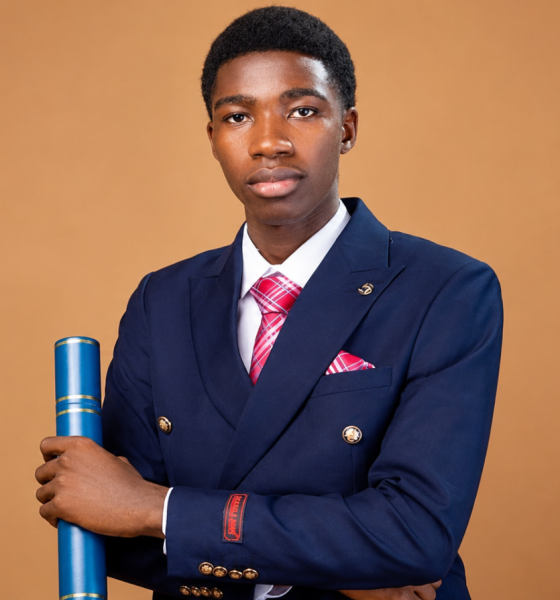
Francis Olusegun, the University of Ilorin’s best graduating student for the 2025/2026 academic session, has attributed his achievement of a perfect 5.00 Cumulative Grade Point Average (CGPA) to self-belief, consistency, adaptability and determination.
Olusegun, a graduate of the Department of Mathematics, disclosed this in an interview published on October 20, 2026, by the Union of Campus Journalists, University of Ilorin.
He said his ambition to graduate with a perfect CGPA took shape after he saw his results in his first year, which convinced him that the feat was attainable.
“I began to imagine graduating with a 5.00 CGPA after seeing my 100-level results. That was when the thought came to me that we could actually break the record,” he said.
The graduate explained that he had always set his sights on becoming the best graduating student wherever he found himself, adding that the ambition became more defined as he progressed through the university.
He said his longstanding passion for Mathematics, which began in primary school, influenced his decision to study the discipline despite its demanding and abstract nature.
“What drew me to the course was my love for it, which started in primary school. I have always enjoyed solving mathematical problems,” he said.
“There is a connection between me and Mathematics, and that made it easy for me to choose it.”
Olusegun said maintaining a perfect CGPA throughout four academic sessions and eight semesters required a strong mindset, consistency and the willingness to change strategies whenever necessary.
“Maintaining a perfect CGPA is not easy, but the first thing is that I had already won in my mind. Even before I started reading or doing anything, I had already won in my mind,” he said.
He explained that he did not depend on a rigid study timetable but adjusted his methods whenever he discovered that an approach was no longer effective.
According to him, revising lessons on the same day they were taught and conducting additional research helped him understand difficult concepts and maintain his academic performance.
“Most of the time, I revise whatever I am taught in class that same day when I get home. I also conduct research to understand the courses better and use available tools to break down complex concepts,” he said.
The Mathematics graduate also identified continuous assessment as an important component of his academic strategy, noting that he paid close attention to test scores because they contributed to his final grades.
He said he aimed to score above 70 per cent in his assessments to strengthen his chances of maintaining excellent results in the final examinations.
Olusegun acknowledged that social media sometimes distracted him but said he deliberately limited its use whenever it threatened to interfere with his studies.
“I can be distracted, especially by social media. There are times when I have to put social media aside, and there are other times when I can return to it,” he said.
He added that achieving his academic ambition required sacrificing some personal pleasures and prioritising activities that aligned with his long-term goals.
The scholar also recounted some of the challenges he faced during his undergraduate studies, including a faulty phone that could not be repaired until after his first-semester examinations in his first year.
He said the situation made studying difficult until a friend lent him another phone, which enabled him to continue reading and practising.
“Fortunately, one of my friends gave me his other phone to use for reading and practising. That helped me get through the period,” he said.
Olusegun further disclosed that financial difficulties occasionally affected his university experience, but he sought assistance from people whenever he could not meet his basic needs.
He said he believed that challenges should not prevent anyone from pursuing their goals, stressing the importance of seeking help when necessary.
“I believe there is no excuse for failure. If there is something I cannot handle on my own, I look for a way to get the help I need rather than allow the situation to stop me from achieving my goals,” he said.
The best graduating student said he was largely self-motivated because his parents, whom he described as uneducated, did not constantly push him academically.
“My parents are not educated, so I cannot say that somebody was constantly pushing me academically. I pushed myself because I knew what I wanted to achieve,” he said.
He explained that he managed academic pressure by remaining calm, assessing challenges and seeking practical solutions rather than allowing difficult circumstances to overwhelm him.
“When I am tired, I rest. There is no point in giving up simply because I am tired or overwhelmed. I take it as a sign that I need to rest before continuing,” he said.
Olusegun credited his parents, church members, friends and former students of his department with providing financial assistance, encouragement and academic guidance throughout his university education.
He said their support came in different forms, including financial help, motivational advice and guidance from graduates who had previously faced similar academic challenges.
Reflecting on his achievement, Olusegun said graduating with a perfect CGPA had strengthened his confidence and encouraged him to pursue greater academic ambitions.
“It means a lot to me. It shows me that I can do more and that this is only the beginning of my greatness,” he said.
He added that he had consistently emerged as the best graduating student from primary school through university and was the first person in his immediate family to earn a first-class degree.
Having achieved his undergraduate goal, Olusegun said he was considering pursuing a master’s degree before a PhD or exploring the possibility of proceeding directly to doctoral studies, with research as his primary interest.
“My next step is to further my education, either by pursuing a master’s degree or going directly for a PhD. I am interested in research, so that is the direction I want to explore,” he said.
He identified mathematical biology, particularly the application of mathematical models to predict and analyse infectious diseases, as one of his areas of research interest.
According to him, mathematical modelling could help public health agencies forecast disease outbreaks, analyse epidemiological trends and make better decisions on the deployment of available resources.
Olusegun also expressed interest in combining Mathematics with emerging technologies, particularly artificial intelligence, to address public health and epidemiological challenges.
Meanwhile, the University of Ilorin held its 41st convocation ceremony for the 2025/2026 academic session from October 21 to 23, with 16,152 graduands expected to receive various academic qualifications.
The Vice-Chancellor, Professor Wahab Egbewole (SAN), disclosed during a pre-convocation briefing that 365 graduands would receive first-class honours.






Princess Omolaoye Adedoyin At 66: Family Celebrates Her Godly Virtues, Prays For Long Life

Osun: Physician Advocates Regular Checkups At Qualified Medical Laboratories

Hausa Zallah Leader Congratulates Hashim on Court Victory, INEC Listing

Osun Police Declare Alowonle, Sibi Wanted Over Emir’s Murder

SSACO Raises Alarm Over Alleged Forced Sale Of Political Stickers To Oyo Drivers

Akande Hails Adeleke For Uniting Osun Political Leaders Behind Tinubu
-

 Crime4 days ago
Police Arraign Three Travel Agency Staff Over Alleged ₦5.6m Visa Fraud In Osun
-
 News4 days ago
Osun: FBOMF Raises Alarm Over Poor School Facilities, Teacher Shortage In Ayedaade
-

 Crime5 days ago
Ondo Police Arrest Two Suspects, Recover Locally Made Guns In Akure
-

 News4 days ago
Toluwanisings: Family Announces October 27 Tribute Night In Ibadan