

News
Dance, Prayers, Colour As Adherents Mark Isese Festival In Osun, Lagos, Oyo, Ogun, Kwara
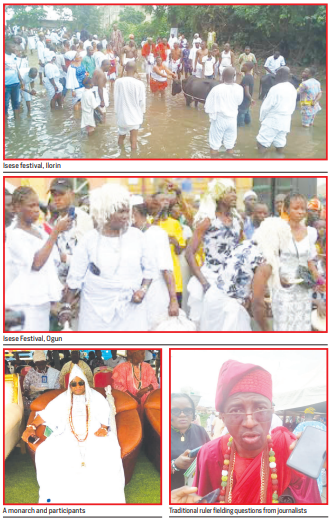
Isese Festival, Yoruba religious and cultural celebration, by adherents of traditional worship and Ifa devotees, assumed different dimensions across South West states, during this year’s event, as the trio of AYOBAMI AGBOOLA (OSOGBO), ADEYINKA ADENIJI (LAGOS), and SOLA ADEYEMO (IBADAN) captured the highlights
Background
I sese, a Yoruba word for tradition, is said to denote different kinds of festivals held by adherents of the Yoruba traditional religion or culture across Nigeria, Cuba, Brazil, the United States, Benin, and other countries. Among the several Isese festivals celebrated majorly by the Yorubas are Eyo, Igogo, Ojude Oba, Olojo, Oro, and Sango festivals.
An essential element commonly placed in the festival celebration is offering sacrifices made to gods like Obatala, Sango, Ogun, Sankpanna, and Esu, which are peculiar to the Yoruba tribe. The sacrifices are championed by Olu-Awo, a chief priest or priestess, with the mandate or instruction from Ifa or Orunmila, a mystical figure or deity of wisdom and intellectual development for direction on the spiritual aspect of the celebration.
Pomp of Ifa
In Osun, the popular Nelson Mandela Freedom Park, Osogbo, venue of this year 2025 Isese Festival, worn a colourful look and was filled to the brim on this fateful day (August 20, 2025) as traditional worshipers from across the state and in diaspora converged on the park, to celebrate one of their most cherished cultural heritage.
For many Yoruba traditionalists, Isese Day is not merely a cultural festival, it is a reaffirmation of existence and connection to Olodumare. The festival held simultaneously across a number of states in South Western Nigeria, and other Yoruba speaking parts of some states in the country, including Oyo, Osun, Ogun, Lagos and Ekiti as we as Kogi, Kwara, and Edo.
The day was declared a work-free day for the state workers in Lagos, Ogun, and Osun to allow people celebrate the festival that has recently become part of the cultural celebration calendar of Nigeria. It was a fun filled and exciting celebration, with colourful cultural display. It was an occasion for both worshippers and acolytes of Ifa tradition to enthrall the people with their practice.
The theme for the celebration in Osun State, was; Boode Odun, Biigbe Nilu Ri (A Happy Home is the Foundation of a Prosperous Nation). Amidst the cultural feasting and all that came with it, one of the most interesting piece of cultural display, was the display by the Ifa priests, with a number of messages coming from the Ifa oracle.
One of the messages from the oracle was a caution to the Governor of Osun State, Ademola Adeleke on his political career, to the effect that a woman could pose a major threat to his political future as the next gubernatorial election in the state approaches, urging him to seek forgiveness from those he has offended to avert the looming challenges.
This is as it revealed that the governor and some political leaders in the state had ‘stepped on toes.’ However, it assured that reconciliation would change the hearts of their adversaries.
Ancestral nod
On the controversial issue of local government allocations in Osun, the oracle was consulted through the traditional Ifa process.
In accordance with custom, kolanuts were cast three times before the assembled priests and devotees, and on each occasion the outcome reportedly aligned in favour of Adeleke. The repeated results were interpreted as a strong spiritual endorsement of the Governor’s position in the ongoing tussle over local government funds.
Traditionalists at the ceremony said the divination was not mere coincidence but a reflection of ancestral will, signifying that despite political wranglings, the matter would ultimately tilt in Adeleke’s favour. They added that the oracle’s verdict should be regarded as both a warning and reassurance, urging political actors to tread cautiously by respecting the cultural authority of Ifa.
Speaking during the festival, the Owa Obokun of Ijeshaland, Oba Clement Adesuyi Haastrup Ajimoko III, represented by Oba Ogboni Ipole Omoniyi Kehinde, stressed that Yoruba monarchs are; “custodians of culture, not custodians of religion.
“Any religion you want to do is inside your room. A king should not be a king of religion, but a custodian of culture. The food we eat and the clothes we wear distinguish us from animals. It is our culture that distinguishes us from Igbo, Hausa, Chinese, and Indians. Once we abandon our culture, we lose that identity.”
Cultural renewal
The President of the Traditional Religion Worshippers’ Association of Osun (TRWASO), Oluomo Dr Oluseyi Atanda, in his keynote address, noted; “Our labour of the last two years trying to sensitize and remind our Royal Fathers of their role has paid off. We can boldly say that we have tangible Royal Fathers that we are proud of.”
Atanda said this year’s theme; A Happy Home is the Foundation of a Prosperous Nation, was borne out of earlier Ifa messages, stressing that cultural values must begin at the family level if Nigeria is to prosper. He further appealed to the state government to harness Osun’s sacred sites as tourism goldmines, particularly the Osun Grove, describing them as; “untapped black gold.
“The Osun Grove alone, if well annexed, can generate enough funds to expand other sites. We must declare a state of emergency on access roads to these sacred places. According to TRWASO leadership; “For us as Onishashe, Trinity is not God the Father, God the Son, and God the Holy Spirit. It is God the Father, God the Mother, God the Ori, and God Olodumare himself.
Nobody can see God, but through His deities, the 400 manifestations, we honour him.” This explained the vibrant attires of worshippers, each representing different Orisha and aspects of Yoruba spirituality. According to them, the celebration aims, “to remind us of the importance of our Ìsese as beacon of heritage and unity.”
The celebration honouring Yoruba traditions extend far beyond the shores of Nigeria. These festivities, often characterised by music, dance, and spiritual rituals, serve as bridge connecting diaspora communities to their homeland.
Yoruba identity
Among the diverse attendees was Chief Ifashayo, a traditionalist from the diaspora, who shared a deeply personal testimony: “I came into this country in a wheelchair. The Orisha saved my life. I feel blessed, empowered, and forever grateful. This practice is generational, it will never end, like the ocean. There’s no end to Orisha, Ifa, and all we practice.”
For Ifashayo, Isese Day is not only about rituals but also a platform for teaching, sharing, and blending Yoruba culture with global traditions. Different speakers at the event repeatedly underscored the fact that Yoruba culture remains the strongest identity marker for the people at home and abroad. One participant said; “This tradition is the only thing that identifies us in the world. Our colour is not white.
Our rituals, our language, our herbs; these are our distinction. Yoruba language is now spoken officially in international communities. In Brazil alone, over 60 million people practice Yoruba traditions.” Unlike other religions, they argued that Yoruba traditional faith expands without force or conversion: “It is the only religion that moves without swords, without guns.
Nobody preaches it, yet the world is coming to us.” The 2025 Isese Day was not only a festival of dance, prayer, and colour, but it was a reaffirmation of Yoruba resilience, spirituality, and identity in a changing world. Isese is used to denote different kinds of festivals held by adherents of the Yoruba traditional religion or culture in Nigeria and Cuba, Brazil, the US, Benin Republic, and other countries.
Isese Day helps strengthen bonds as some see this day as the time to reconnect with ancestral wisdom, honour the spirits of their forefathers, and reinforce the bonds of community. “Isese Day is more than a celebration; it’s a reminder to stay connected to our roots, honour ancestral wisdom, and pass on traditions.
In a changing world, Isese Day shines as a beacon of cultural identity, preserving Yoruba heritage for future generations.” From the Ifa prophecies on politics to calls for cultural reorientation, from testimonies of survival to appeals for tourism development, the celebration highlighted both the challenges and hopes of the Yoruba people.
Preserving a heritage
The beating of drums, the chanting of ancient incantations, and the smell of incense which filled the air at Ijaiye, under Ojokoro LCDA in Lagos State, was the trademark as the cultural celebration underscored the identity, resistance, and survival of the people. For the people of Ijaiye, this year’s commemoration was particularly symbolic.
Traditional leaders, custodians of the community’s spiritual heritage, came together to pay homage to their forebears, renew their bond with the gods, and remind Nigerians that culture remains the soul of a people. Speaking with New Telegraph, the Baale of Ijaiye, High Chief Oluwafemi Akinwale Akintounde, reflected deeply on the significance of the day.
“We thank Almighty God and our forebears for protection and the growth of Ijaiye and Ojokoro as a whole,” he said. “The celebration of Isese Day is important because a people’s culture defines their essence. Without culture, there is no identity,” he added.
Akintounde lauded the six South west governors for officially recognising the Day as a work-free day, calling it a step in the right direction to preserve Yoruba values. He, however, went further to challenge the federal government to declare August 20 a national holiday. “As it stands, the declaration is only for civil servants in the Yoruba-speaking states. But the richness of our heritage is not limited to the Yoruba alone. This is about Nigeria’s identity and pride.
The federal government must see the urgency in elevating Isese to national recognition,” he urged. The Baale also used the celebration to call for better organisation among Yoruba traditional worshippers. With stronger networks, better documentation, and improved dialogue with the government, they believe traditional religion can play a more visible role in nation-building.
“The Yoruba heritage is one of the richest in the world. Our proverbs, our divination systems, our festivals, these are assets that can be harnessed not just for spiritual growth but also for economic revival through tourism and cultural exchange,” Akintounde noted. He stated that many of Nigeria’s challenges, from corruption to economic instability could be addressed if traditional values such as honesty, communal responsibility, and respect for elders were restored.
Rituals
At the heart of the celebration was the Abore (chief priest), Chief Toheeb Olaleye, who led the rituals, supplications, and offerings. With kolanuts, palm oil, and other symbolic sacrifices laid before the shrine, the air was thick with reverence for the ancestors. Olaleye explained that these rituals are not about fear or secrecy, but about renewal, guidance, and communal prosperity.
“Isese Day is a reminder of our connection to the gods and to nature. It is our way of resisting attempts by foreigners to erase our memory. Our rich culture, when properly observed, is the surest path to bail our nation out of its economic troubles,” he said.
According to him, African traditions hold answers to Africa’s crises. By keeping faith with indigenous wisdom, the people can liberate themselves “totally from all forms of slavery; economic, mental, and cultural.” One striking message from the gathering was a direct defense of Yoruba traditional religion against long-held misconceptions.
Olaleye firmly rejected the narrative that the practice is shrouded in secrecy or tied to sinister forces. “There is no deadly secrecy in Ifa or Isese as enemies of the people want us to believe. Our faith is about harmony, peace, and community well-being. What we keep sacred is no different from what other religions revere. To demonise our culture is to demonize ourselves,” he declared.
The Abore also stated that when properly annexed, Yoruba tradition can be a tool for cultural diplomacy, placing Nigeria on the global stage not only as Africa’s largest economy but also as a cultural powerhouse. As the drumming subsided and libations were poured, one message rang out clear from Ijaiye: culture is power.
For the Yorubas, August 20 is not just a date, it is a living testimony of resilience in the face of centuries of suppression and cultural erosion. For Nigeria, it is a chance to embrace a more inclusive identity that recognises and honours all its traditions. Until then, communities like Ijaiye will continue to beat their drums, pour their libations, and call on the gods.
This, they would, not just for protection, but for a country that remembers who it truly is. In Oyo State, celebrants trouped out in their numbers, with great expectations pervading the air to partake in the yearly celebration that has over the years witnessed the adulation of Ifa tradition by the devotees and adherents.
On this day, it was obvious from the conviviality and colours that filled that Isese Festival is an occasion that unites not only the Yoruba race, but the global community that values spiritual and cultural diversity. Lekan Salami Sports Complex, Adamasingba, Ibadan, venue of the celebration brimmed with quite a number of symbolisms that are associated with the festival as the traditional adherents of Ifa and alternate religion displayed the essence of their religion and cultural practice.
Chief celebrant pledges support
The chief celebrant of the day, by way of speaking, Oyo State Governor, Seyi Makinde, who was represented by the Commissioner for Culture and Tourism, Dr Wasiu Olatubosun, assured Isese adherents that his administration will continue to promote and support them to preserve the cultural and traditional heritage of the people.
This is as the appreciative traditional worshippers expressed the belief that the celebration was capable of engendering spiritual and cultural identity to share traditions with the world at large and to show that Isese is a path of peace, tolerance and respect for humanity.
Among the boisterous crowd that witnessed the religious celebration were some of Isese leaders including: the Aare Isese of Oyo State, Chief Omikunle Egbelade, and Araba/Olu-Isese of Ibadanland, Chief Ifalere Odegbemi; the President, Traditional Religion Worshipers Association of Oyo State, Surveyor Dasola Adefabi; the Asiwaju Awo of Oyo State, Chief Olufade Olanipekun; as well as, the Olubadan of Ibadanland designate, Oba (Senator) Rashidi Ladoja, who was represented by Mogaji Adesina Olatunji Aresa, among others.
At the event, which was the grand finale of the 2025 Isese Festival with the theme: Unity is the way to success, Makinde commended all the devotees for their peaceful co-existence, tolerance and support to the government, and for upholding the cultural heritage through the preservation of traditional beliefs across the different geo-political zones of the state.
He urged them to continue to make traditional festivals and beliefs attractive to the young ones in order to preserve the heritage. Earlier, while speaking in his capacity as the Commissioner for Culture and Tourism, Olatubosun lauded Makinde’s effort in getting Sango Festival enlisted and recognised as the first Yoruba cultural festival of Intangible Cultural Heritage of Humanity by the United Nations Educational, Scientific and Cultural Organisation (UNESCO).
He said, “I want to express gratitude to the Governor for always keeping to his promises. Let’s recall, during the electioneering period, he did promise that if he became the Governor, he would ensure there is a holiday for the celebration of Isese Day and, today, it has become a reality.
“Apart from that, he promised that in his administration, there would be equality in the three major religions in the state — Christianity, Islam and traditionalism. This shows he is a Governor for all. We have been clamouring for this for a long time in Oyo State, all to no avail. But since Governor Makinde came on board, he has ensured that every religion is carried along and we are happy with this development.
“For all of these achievements, our elders are expressing gratitude. We have been celebrating this event in the stadium since last year and we are very happy to be here. I am glad about the turn out today’s event is witnessing. Seeing even the little children gladdens my heart. Having said that, I want to urge us all to continue to support the governor, who has started well, so that he can end well”.
Unity on display
In his goodwill message, the Olubadan of Ibadanland designate, Oba (Senator) Rashidi Ladoja, through Mogaji Adesina Olatunji Aresa, thanked all the stakeholders for their cordial relationship and assured of his support to Isese celebration and their beliefs.
The President, Traditional Religion Worshipers Association of Oyo State, Surveyor Dasola Adefabi, also in his goodwill message appreciated Makinde for declaring August 20 every year as a work-free day for the celebration of Isese, stressing that the Governor has not only acknowledged the importance of their faith but has reinforced the spirit of unity and respect among the diverse religious and cultural communities.
He appealed to the Isese adherents to continue to promote peaceful co-existence among themselves. Speaking through his sermon, titled: Unity, the Asiwaju Awo of Oyo State, Chief Olufade Olanipekun, emphasised that good communication, cordial relationship and support to leaders in government at all levels should be their priority to foster progress and development.
He, therefore, urged the leaders of Isese religion to encourage youths through innovation and use of modern technologies in their various environments to enhance their inclusiveness in the sacred heritage. Earlier in their separate welcome addresses, the Aare Isese of Oyo State, Chief Omikunle Egbelade, and Araba/Olu-Isese of Ibadanland, Araba Ifalere Odegbemi, appreciated the benevolence of the creator for the opportunity to witness another celebration of Isese Day in the state.
They also thanked Makinde for his unwavering support and commitment to the tradition and cultural heritage which had promoted unity, peace and oneness of all the religions. They noted that the Isese Festival unites not only the Yoruba race, but the global community that values diversity, spirituality and cultural identity to share traditions with the world at large and to show that Isese is a path of peace, tolerance and respect for humanity.
They called on all adherents to continue in unity to preserve the traditions and protect spirituality of Isese to stand as a beacon of wisdom for generations yet unborn. Highlights of the celebration were the parade of orisa colours, special performances and traditional dances from representatives of the 33 local governments across the state.
ICIR calls on Tinubu
It is not all the six South Western states were Isese Festival is celebrated annually that have declared a work free day to allow for the celebration of the festival across board. However, the International Council for Ifa Religion (ICIR) has called on President Bola Ahmed Tinubu to accord Isese adherents national recognition as in the case of their Muslim and Christian counterparts, by declaring August 20 and 21 as public holidays.
It also called on governors of Ekiti, Ondo, Kwara, Kogi, Edo and Delta states to emulate their colleagues from Lagos, Ogun, Oyo and Osun states who have declared August 20 as Isese Festival holiday to do so as well. In a communique signed by its President, Dr Fayemi Fatunde Fakayode during the 2025 Isese Day celebration, ICIR said that the Presidency should rise above the state of inequality among the three major religions in Nigeria by giving due recognition to Isese practitioners through the declaration of public holidays.
Fakayode, while congratulating Isese adherents all over the world and appreciating the South-West governors who have declared a holiday for Isese Day celebration, demanded that the federal government should fund cultural festivals, protect shrines and sacred lands and integrate practitioners into national cultural councils.
He also stressed the need for the federal government to invest in cultural sites nationwide to boost revenue and community growth. Traditionalists in Ogun State used the occasion to call on the state government to also accord Isese Day the same level of recognition and treatment given to Christmas and Sallah celebrations to preserve Yoruba cultural heritage.
This is as they also called for financial support for the adherents, wondering why the state government after declaring August 20 as Isese Day festival, could not support the worshippers financially as it does for Christians and Muslims during their celebrations, urging the state governor, Dapo Abiodun, to consider their plight.
Head of traditional worshippers in the state, Eniowo Aregbesola Anipupo, made the appeal at OkeBola, venue of the traditionalists’ praying ground, while calling on the administration of Governor Abiodun Dapo, to consider every religious body as the same under God, without leaving anyone out.
Anipupo, however, admonished traditional worshippers to endeavour to make peace and be tolerant with Muslims and Christians for the sake of unity, stressing that it was high time the three religious bodies came together as brothers to live in harmony.
The state government, through the Commissioner for Culture and Tourism, Sesan Fagbayi, said that the administration cared about traditionalists since it approved August 20 as the Isese Day celebration, appealing to them to see themselves as one and be at peace with other religious bodies.
The Alake and Paramount Ruler of Egbaland, Oba Adedotun Gbadebo, who was represented by Oluwo Ifa Itoku, Olusoji Sodamola, charged the traditionalists to imbibe the spirit of humility and shun any form of violence during the celebration.
® New Telegraph
















Osun NLC: We Requested ₦20,000 Palliative For Workers, Not Vote-buying

‘We Want Peace’ — First Lady Leads Protest To Police HQ, Demands Police Action Ahead Of Osun Poll

Atiku, Aregbesola, Mark Rally Osun Voters For ADC Ahead of Saturday Poll

Osun Guber Poll: Muslim Scholars, Imams Endorse Oyebamiji

Osun Guber Poll: Muslim Scholars, Imams Endorse Oyebamiji

Ogun Poultry Farmer Abducted, Kidnappers Demand 500m Ransom
-
 News5 days ago
Just In: Tinubu Orders EFCC To Vacate Court Order Freezing Osun Government Accounts
-
 News5 days ago
Tinubu Applauds Rescue of 308 Kidnap Victims, Orders Stronger Early Warning Systems
-

 Foreign News5 days ago
UK Appoints Vicky Seymour As Deputy High Commissioner In Abuja
-

 Entertainment5 days ago
BBNaija: Flora Fights Back Tears After Learning She’s A Gambit