
News
Adeleke And His Saturday bulldozer By Lasisi Olagunju
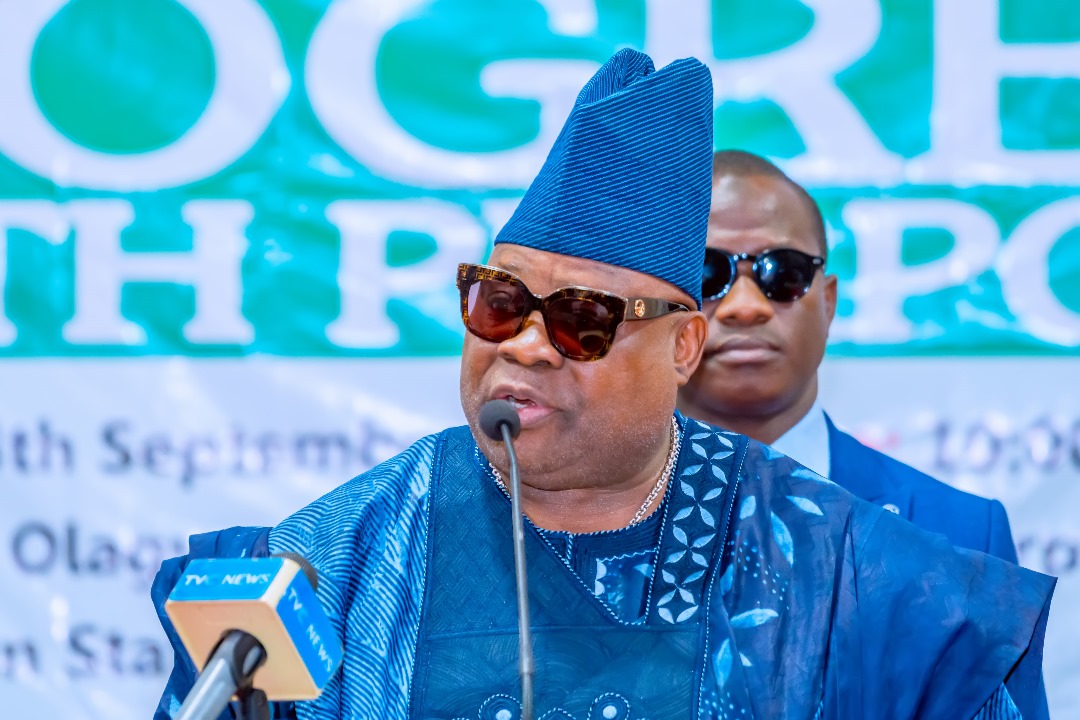
APC leaders are falling over one another to own Ademola Adeleke’s victory — the same people who, barely 24 hours earlier, fired missiles to bring down his plane. They now say he had all along been their preferred candidate. Since when did the hawk and the chicken become playmates? Ẹyẹ ń bá ẹyẹ ṣeré, ẹyẹ ń tu ìyẹ́ ẹyẹ. One bird claims to be playing with another while quietly plucking its feathers. How warmly should the saved, fresh from the gallows, embrace the executioner whose rope just failed?
Tuesday last week, at the Arise News TV/Nigerian Tribune Town Hall meeting for candidates in the Osun State governorship election, I asked Governor Ademola Adeleke if he was not scared of contesting against the APC — a party with more than 30 governors, the presidency and virtually everything that comes with federal power. His response was vintage political boast: “You don’t know me o. I am a bulldozer. They are not calling me Action Jackson for nothing.” He promised to level the APC and its awesome structures.
On Saturday, the people of Osun State climbed onto Action Jackson’s bulldozer. Together, they levelled the field and much of what the APC had erected on it. The bull was dazed.
Adeleke and his people made it against all odds because they understood the practical instruction in the Yoruba saying: Ọ̀pá kan ò p’ejò (one stick does not kill a snake). With more than one club, they killed the snakes of invasive power. They borrowed pages from the classic underdog playbook: shifted the battlefield, endured the blows, disrupted the enemy’s calculations, and like Scipio before Hannibal’s elephants, they learnt that terrifying weapons lose their terror once you discover how to unsettle them.
Sir Rex Niven, in ‘The War of Nigerian Unity’, described what he called the Abagana miracle: a formidable Nigerian military convoy of men, machines and munitions suddenly brought to ruin by an underdog on March 31, 1968. In Osun, what ordinarily should happen when enormous political and military machinery confronts a smaller force did not happen. Ancient Chinese military strategists had expressions for such improbable victories of the weak: yi lie sheng you (using the inferior to defeat the superior); and yi ruo sheng qiang (using the weak to defeat the strong).
Machiavelli has two political animals in his zoo: the lion and the fox. One is blessed with the strength for decisive action; the other with the guile for shrewd manoeuvring. Battles may be won by the lion’s strength; the long game of politics requires the fox’s cunning. In the Osun election, the victorious knew the referee belonged to their opponent, they flooded the field with lights of every colour until even a biased referee could no longer see well enough to help his side.
The victor particularly benefitted from Field Marshall Idi Amin’s advice to boxers: “the only chance to defeat the referee who is against you is to win by knockout. Don’t try to win on points—you will be cheated. Knock out your opponent, so the referee has no choice.” Saturday was a knockout; the umpire dithered, then surrendered. Would INEC have given victory to Accord at the weekend if Adeleke had relied on winning on points? The lesson there for anyone planning to contest against the APC next year is: since you suspect the referee, do not leave your victory to the referee’s arithmetic, start training with Iron Mike Tyson; only a knockout will defeat your opponent.
Saturday’s election in Osun State, and the way it went, demonstrated in clear terms the limit of federal power. The whole of the Nigerian security agencies emptied themselves into Osun State. The whole of over thirty state governments and their governors and their money poured into the state. The awesomeness of the presidency hid behind its index finger and feigned sleep while the Osun operation was underway. Yet, at the end of the day, nothing happened that gave the invading forces cause to clink glasses. They came with power, numbers and money. They left with defeat.
“They cannot win who start with threats” (Avianus). Indeed, pressure has a way of empowering the very resistance it is deployed to overcome. Read Aesop’s ‘The North Wind and the Sun’ and how spectacularly the howling wind lost to the blazing sun. Nigeria’s politics and politicians invested so much dread in the power called federal. Osun has taught some hard lessons. Even Adeleke learnt his own: you do not have to pawn yourself to the king before you can survive.
What we saw in Osun State was a practical definition of people power. Democracy, to the ancient Greeks, meant political power “wielded actively and collectively by the demos” – the people. Political scientist and classicist, Josiah Ober of Stanford University, writing on public speech and the power of the people, argues that democratic Athens demonstrated how the collective power of the people could check elite political domination. The “power of the people”, he says, was not a disguise for government by an elite. On Saturday, Osun supplied its own footnote to ancient Athens. Other states should learn from Osun.
The contest was a real rumble in the jungle. The APC fought really hard with everything and reluctantly lost. The Accord won because it had a determined people backing it with grit, resolve and audacity. When a dog has people behind it, it will kill monkey for supper.
In 2009, Chinese political scientist, Yang Shaohua, wrote ‘How Can Weak Powers Win?’ He asked an enduring question in the study of conflict: how does the weak sometimes defeat the strong, and why does superior power sometimes fail against an inferior adversary? “The history of war can be characterized as the strong defeating the weak, and the many defeating the few,” Shaohua wrote. Yet the history of war is also repeatedly interrupted by reversals of that supposedly natural order. Its records are regularly updated with new Davids bringing down new Goliaths. We witnessed one on Saturday in Osun State.
Every politician knows that politics sometimes behaves like war. Democracy exists to ensure that it does not become one. The election may have come and gone but the wounds it inflicted will not go in a term.
People died; limbs got lost. Democracy as we knew it got wounded. A few days ago, we were horrified at iron scavengers hacking at pillars of bridges in Lagos. I watched Osun from a close distance and saw democracy at the mercy of merchants of power eating into the values that make democracy democracy. And like the bridge destroyers, the political invaders were not bothered that the structure from which they were extracting goods is needed to carry everybody across the rivers of tomorrow.
That is the frightening thing about the kill-or-lose politics that has consumed our democracy. An election is supposed to renew democracy. The murderous campaigns that dovetailed into Saturday in Osun State cannibalised it.
Now, going forward, ignorant us may imagine that the only issue for determination is who won that election. But it is not the only issue. There is a larger question: what is now left of the bridge after the war?
“Everybody who created democracies understood that they were fragile systems, which is why they put checks and balances in place.” Journalist and Pulitzer Prize-winning historian, Anne Applebaum, unconsciously had our broken system in mind when she uttered those words last month. The “checks and balances” are the pillars that hold the structure. They were assaulted and assailed by scavengers incrementally in the just concluded election.
Democracy was invented and repeatedly strengthened because humanity needed a way of crossing the gulf between competing interests without settling the argument by violence. The tragedy now is that scavengers are hacking at its pillars and stealing the steel that keeps the bridge standing.
What are those pillars? My teacher said the rule of law is one. The neutrality of state institutions is another. The freedom of citizens to choose without fear is another. Peaceful competition, tolerance of opposition and acceptance that today’s loser may become tomorrow’s winner are reinforcing rods buried deep inside those pillars. Remove enough of them and the bridge may continue standing only for a while. That apparent solidity is deceptive. I know you would call me a scare monger, that this Nigerian bridge is solid and sound, no matter what we may have done to it, “nothing do am.” That is how the Romans felt with their democracy until they lost it to the Caesars; the Athenians held same belief to the sorrow of their democratic freedom. They lost it. This democracy is close to midnight. A bridge does not have to collapse immediately after its steel is stolen for the vandalism to be fatal.
And this is where Osun should worry us. Politicians of all sides did not mind vandalising the institutions that give democracy meaning. All they wanted was victory.
Saturday taught Adeleke how to survive the fist of power. Defying all odds, he won with 511,067 votes against the 444,815 polled by APC’s Bola Oyebamiji. The winner has pledged allegiance to the godfather of the loser. Adeleke said on Sunday in his victory speech: “President Bola Tinubu is a son of Osun State and I hereby reaffirm my earlier endorsement of him for a second term in the 2027 presidential election.” The days ahead may teach Adeleke that the handshake of power sometimes requires even greater vigilance than the war he just fought and won.
We may have more surprises ahead. How will it feel if victorious David is asked to enlist in Goliath’s army? APC lost to Accord on Saturday. I will not be shocked if APC now pointedly demands an alliance with Accord and Adeleke for the 2027 contest for all posts. Indeed, President Bola Tinubu, whose forces were defeated on Saturday, reportedly called Adeleke when his victory was certain, before he was officially named winner. Was that call just a congratulatory call or was it strategic reconnaissance? The president certainly has his eyes on harvesting his conqueror as a useful vassal.
There is an old political lesson underneath this: when the stronger man cannot defeat the weaker man, wile may suggest that he makes the weaker man’s victory useful to him.
It will happen, and when it does, how will the relationship end? Adeleke and his people have an old story of Nabis of Sparta versus Rome to learn from. History says Nabis had been aligned with Philip V of Macedonia, but during the Second Macedonian War, the Romans, under Titus Quinctius Flamininus, made an alliance with Nabis because they needed his assistance against Philip. Nabis agreed and shifted sides; they had a nice time. The Yoruba say all adulterous relationships end in a fight. When Rome needed Nabis, Rome called him a king, and accepted him as an ally; when the need had passed, Rome called him a tyrant and turned against him. The Roman historian, Livy (59 BC to AD 17), preserves the substance of Nabis’s taunt: “I am the same man with whom you entered into alliance; then you called me king, now you call me tyrant.” Rome demonstrated here, as it did repeatedly, that it did not have to destroy every opponent. Sometimes the more profitable conquest came after the fighting stopped. The message for last Saturday’s victor is that yesterday’s enemy will treat him as today’s indispensable ally; that does not protect you from being treated tomorrow as an enemy once your usefulness expires.
They should also read the history of Pyrrhus and the Romans. Pyrrhus defeated Rome at Heraclea. After that victory, he sent his extraordinarily persuasive envoy, Cineas, to negotiate peace with Rome. History says Rome refused. Pyrrhus would later defeat the Romans again at Asculum, although at such enormous cost that his name gave history (and English) the expression ‘Pyrrhic victory.’ This should serve those in Osun who may intend to dash their victory to the party that slammed the door on their hand of friendship before the war.
However, while we celebrate this victory, we need some silent moments of reflection. With every election come winners and losers. Losing an election can feel like losing a war. In that moment of defeat, you lose more than the trophy. In his ‘After Defeat’, S. Clinton Hinote writes that in defeat, we lose “the confidence of our friends and the respect of our foes.” Those who lost in Osun on Saturday will tell you that this theory and the theorist are right.
Political scientists will tell you that losers in politics are of two types. Kenneth A. Shepsle lists them as “out-of-power politicians and in-power politicians with distinctly out-of-favour ideas.” Saturday’s election had them; tomorrow’s will have them too. Democracy would be dead if politics were all about winning. Fortunately, neither victory nor defeat is final. Human experience teaches us that much. For those who lost, there is always a tomorrow if they are prepared to change, rethink and rebuild. The winner, too, must manage victory in such a way that today’s gain does not become tomorrow’s loss.
There are lessons from economics here. E. C. Capen and his colleagues gave us the “winner’s curse”; Charles A. Holt and Roger Sherman wrote about the “loser’s curse.” Both insights from the marketplace are useful in understanding politics and its swings of fortune. There can be a curse in winning badly and another in losing without learning. Looking back at the Osun battle, I would tell the winner that the machine required to win a political war is not necessarily the instrument with which one should govern after victory. Action Jackson drove his bulldozer through Saturday with remarkable success. His harder assignment is to know where to park it and what to do with the cleared field. May God help him.





Akande Hails Adeleke For Uniting Osun Political Leaders Behind Tinubu

Ebola: FG Quarantines High-Risk Contacts, Tightens Airport Screening

Alia Explains Opposition To Automatic Tickets For Benue APC Lawmakers

Osogbo: Two Remanded Over Alleged Assault On IBEDC Staff

Osun Mobilises Security Agencies for New Traffic, Park Management Law

Adeleke Pledges Support As Osun Benefits From Remi Tinubu’s Food Programme
-
 Crime3 days ago
Police Arraign Three Travel Agency Staff Over Alleged ₦5.6m Visa Fraud In Osun
-
 News5 days ago
Why should Tinubu Campaign? He Has Won By Lasisi Olagunju
-
 News5 days ago
Emir’s Murder: Osun Police Declare Alowonle, Sibi Wanted, Arrest Six Suspects
-

 News3 days ago
Osun: FBOMF Raises Alarm Over Poor School Facilities, Teacher Shortage In Ayedaade