
Health
Sickle Cell Groups Urge Mandatory Genotype Screening For Nigerians
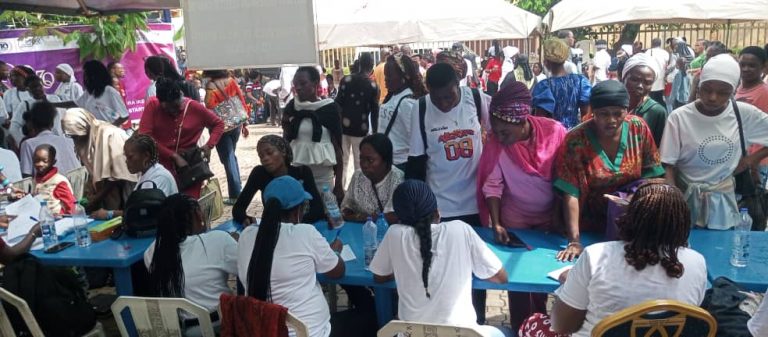
Sickle Cell advocacy groups in Lagos have called on both federal and state governments to enact legislation mandating genotype screening for all newborns and citizens, as part of efforts to curb the rising prevalence of the disease in Nigeria.
The call was made by the CrimsonBow Sickle Cell Initiative and the Sickle Cell Advocacy and Management Initiative during a Sickle Cell Awareness Walk and Free Clinic held for about 1,000 patients in Lagos.
The event, which also marked the 70th birthday celebration of the initiatives’ Patron and Sponsor, Mr. Wole Adeleye, was held in commemoration of the 2025 World Sickle Cell Day.
Speaking at the event, Ms. Timi Edwin, Founder and CEO of CrimsonBow Sickle Cell Initiative, expressed concern over the increasing rate of sickle cell cases in the country and stressed that mandatory genotype testing is a critical step forward.
She emphasized that government commitment is essential to safeguarding future generations from the burden of the disease, while also noting that sickle cell is not a death sentence for those living with the condition.
“It is important to create awareness of sickle cell disorder. Nigeria must act now to reduce the burden of sickle cell in the next generation.
“We need laws to support the eradication of sickle cell disease, especially compulsory newborns genotype testing, we want the government to pump more money into the health system,” Edwin said.
According to her, for the people living with sickle cells to be well taken care of, there is the need for a more vibrant health insurance and cheaper healthcare system.
On the free clinic, Edwin said that both initiatives invited health consultants, qualified doctors, lab scientists, psychologists and other experts to provide free services and medications to patients.
Also speaking, Mrs Toyin Adesola, the Executive Director of Sickle Cell Advocacy and Management Initiative (SAMI) said that Nigeria had a lot of people living with sickle cell disorder, hence the need for policy makers to make it health emergency.
“The time to help multiple people living with sickle cell in Nigeria is now. Nigeria has a lot of them and it is really challenging. We need well-meaning people to join the advocacy.
“Sickle cell is not a death sentence, I am going to be 60 this year, all that the patients need is support, I had a lot of support and that kept me going,” Adesola said.
Sharing experiences, Mr Wole Adeloye, a 70-year old sickle cell survivor and ardent sponsor of the cause, said that policy makers should make treatment and care less expensive for people with sickle cell.
Adeloye, who expressed gratitude to God for attaining 70 years carrying the disorder, stressed the need for quality healthcare, checkups, medications and health insurance.
He said: “New-born testing is the most important thing. We cannot also over stress the need for prophylactic penicillin for patients.
“Another very important drug is hydroxyurea especially for children that goes through a lot of crisis.
“I however, find out that very few doctors knows how to prescribe hydroxyurea , and I would like to see that changing. Pains’ management for sickle cell all that needs to improve.
Speaking, Mrs Christina Bakare, Project Coordinator, CrimsonBow Initiative, who noted that Nigeria had the highest number of sickle cell patients in Africa, called on the National and State Assemblies to save the country and future children.
Mrs Bola Deji- Adeyale, a 47-year old survivor, who called for more awareness and government involvement, disclosed that early signs of the disorder was different from one person to another.
“For a person like me, it was not discovered until I was 12, it came with a lot of pains. People often die because the testing are not done early enough,” she said.
Reeling out five of her doctor’s 10 commandments, Deji-Adeyale listed water drinking, daily medication, avoiding stress, extreme weather and knowing limits.
It was reported that the groups provided free medical consultations, tests and treatment for hundreds of patients.
The group embarked on the awareness walk to and fro from Rotary’s District 9110 at Ikeja GRA to Ikeja under-bridge, singing and dancing while also distributing flyers to create awareness of the need for genotype testing.
Source:The Nation.

-

 News5 days ago
‘You’re A Beacon Of Hope And A Mother To Many,’ Adelabu Lauds Mrs Oyetola At 66
-

 News5 days ago
Adeleke Summons IBEDC, Reassure Rainstorm Victims Of Emergency Support
-
 News5 days ago
Reconciliation Still Possible After PDP Factional Convention —Gbenga Hashim
-

 News4 days ago
ADC Crisis Rooted In Legal Process, Not External Influence — Lawyers Explain