
News
Nigeria Must Tackle Health and Environmental Issues Locally — Experts Warn
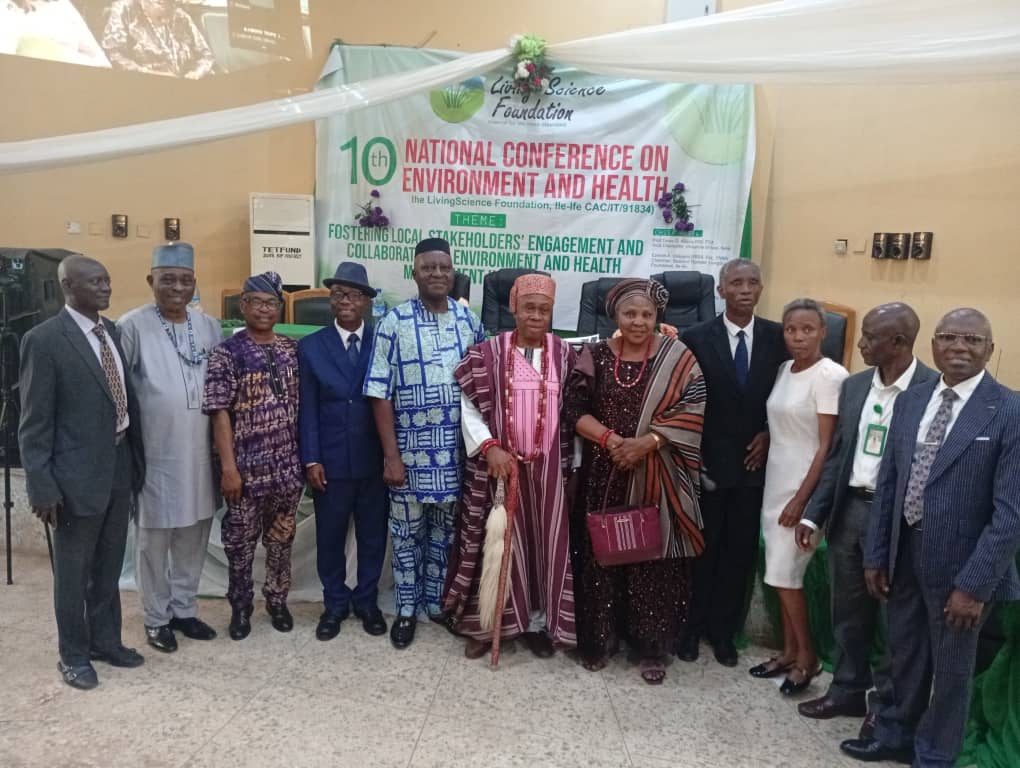
Health and environmental experts have called for stronger community involvement and indigenous solutions in addressing Nigeria’s public health and health and environmental challenges.
This was reinforced at the 10th National Conference on Environment and Health, held at the University of Ilesa, Osun State under the theme “Fostering Local Stakeholders’ Engagement and Collaboration in Environment and Health Management in Nigeria.”
The event, sponsored by the Living Science Foundation, brought together academics, policymakers, and community leaders to discuss how collaborative action can drive sustainable health and environmental management across Nigeria.
In his keynote address, Professor Debo Adeyewa, a meteorologist and climate scientist, emphasized the interdependence between humans, animals, and the environment.
He urged Nigerians to embrace the “One Health” framework, which recognizes that human well-being depends on a healthy environment.
“Everything around us; trees, water, animals, and even the air we breathe, is interconnected,” Prof. Adeyewa said. “We must take care of our environment and ourselves. Clean water, sanitation, and hygiene are more important to community health than one-off medical interventions.”
He also advised the government to adopt a bottom-to-top approach in implementing health and environmental policies by engaging youth, market women, traditional rulers, and other local actors.
On vaccination and public health, the guest speaker stressed the need for transparency and community engagement, saying that while vaccines are beneficial, they should not overshadow preventive measures like hygiene and nutrition.
Representing the Vice Chancellor of the University of Ilesa, Professor Taiwo Olufemi Asaolu, the institution’s ICT Director, Mr. Oladipo Folorunsho, highlighted the university’s commitment to environmental responsibility.
He said the school enforces cleanliness, runs environmental education courses, and partners with waste management agencies to maintain a sustainable campus.
“We encourage the public to see waste as a resource through recycling and proper disposal,” Folorunsho said. “Environmental management and health go hand in hand.”
Also speaking, Bishop Dapo Asaaju, Distinguished Professor of Theology at Lagos State University and former Vice Chancellor of Ajayi Crowther University, linked environmental stewardship to spiritual and moral revival.
“Our traditional and religious values teach respect for nature and one another. We must return to those roots,” he said. “Healing begins when we live right, physically, spiritually, and environmentally.”
In his remarks, Professor Joshua Ojo, President of the Living Science Foundation and Professor of Environmental Health and Safety at the University of Ilorin, reaffirmed the foundation’s mission to promote indigenous, science-based advocacy.
He warned against the uncritical adoption of genetically modified (GMO) foods, arguing that Nigeria’s food insecurity stems more from insecurity and post-harvest wastage than from seed quality.
“No country has achieved food security through GMO crops,” he said. “We must build food sovereignty and health resilience from within, not depend on foreign agencies for our survival.”






Insecurity: DSS Uncovers Plans To Abduct School Children In Edo, Arrest 1 Suspect

ADC Condemns Reported Violence In Ede, Osogbo, Demands Investigation

Journalism Should Not Chase Attention, It Must Redirect It — Harbinger Publisher

Osun 2027: Ex-minister, Lai Mohammed, Adeleke’s SA, Durojaye Call For Credible Polls, Charge INEC In Germany

Osun 2026: Democracy Is A Contest Of Ideas, Not Violence, Oyebamiji Tells Adeleke

Osun 2026: Adeoti’s Loyalists Dismiss Defection Rumours, Reaffirm Support For Adeleke’s Re-election
-

 Opinion4 days ago
Rising Allocations, Failing Infrastructure: Why Nigerians Are Asking Hard Questions By Adeboye Adebayo
-

 News3 days ago
Despite Resignations Of Some Members, We Remain Undaunted, Unshakeable, Osun APC Assures Members, Public
-

 South West News5 days ago
Oba Adebisi Installs New High Chief Orisa
-
 News4 days ago
Osun 2026: AMBO’ll Prioritise Agriculture, Economic Growth — K-RAD